How should you measure and report paint viscosity?
Report the measurement method, instrument or cup, material condition, test temperature and result with units together. A flow time in seconds needs its cup system and nozzle identification. A rotational viscosity result needs the relevant geometry and test settings. Before comparing either result with an application limit, confirm that the product instructions specify the same measurement basis.
For marine contractors and coating QC teams, this prevents an incomplete number from becoming an unsupported instruction to add thinner. Start with the exact coating and component codes, the approved test procedure and the current product documents. This guide helps organize that review and the resulting record.
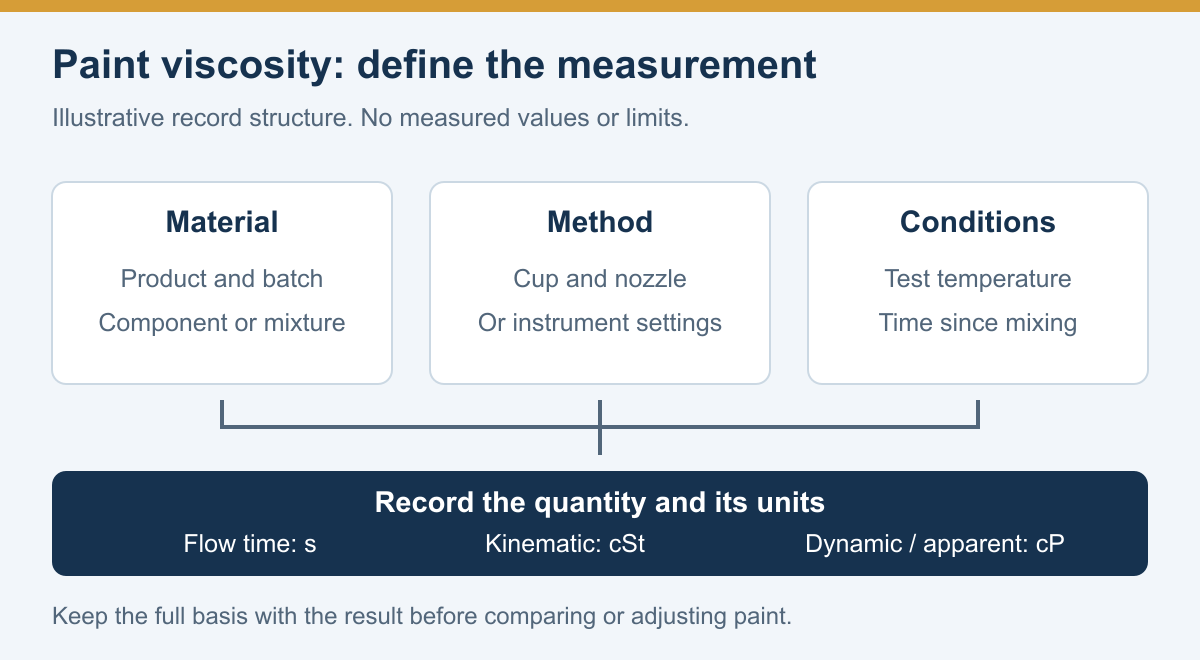
Distinguish seconds, kinematic viscosity and dynamic viscosity
These quantities answer different questions. Keep the original reported quantity visible, even when an approved calculation adds another value.
| Reported quantity | Unit examples | Interpretation |
|---|---|---|
| Flow time | s, with identified cup and nozzle | Elapsed time under that cup method. Seconds from different cup systems are not interchangeable. |
| Kinematic viscosity | mm²/s or cSt | A viscosity quantity obtained through an applicable measurement or validated conversion. 1 mm²/s = 1 cSt. |
| Dynamic or apparent viscosity | mPa·s or cP | Report the method and conditions. 1 mPa·s = 1 cP. For a non-Newtonian material, the test conditions are essential to interpreting the result. |
AMETEK Brookfield's explanation of viscometer operation distinguishes these viscosity units and explains dependence on shear conditions. Density is needed when converting between kinematic and dynamic viscosity on an applicable basis. Do not assume cSt and cP have the same numerical value for paint.
A conversion from flow time additionally needs the relationship for the specific cup and its valid range. Keep the cup designation, original seconds, conversion reference and calculated unit in the report. This article provides no universal seconds-to-viscosity equation or JD acceptance target.
Select a method that suits the coating
ISO 2431:2019 remains the published edition in ISO's public catalog, confirmed in 2025. It concerns flow-time measurement for consistency control. Its scope excludes common dipping cups and cups with replaceable jets. It also requires a determinable flow breakpoint. Do not label an arbitrary dip-cup reading as an ISO 2431 result.
Use the method named by the product or agreed inspection procedure. A suitable flow cup can provide a useful consistency check for a material that behaves appropriately in that test. A heavily structured coating may instead need a specified rotational or rheological method. The selection question is whether the method can produce a meaningful result for this material, rather than which instrument happens to be available.
For rotational testing, retain the instrument, spindle or geometry, speed or shear rate, temperature and reading time required by the procedure. A single apparent-viscosity value cannot describe every application condition. Seek technical clarification when the supplier's target uses a different instrument or omits the test settings.
Control temperature and sample history
The Elcometer 2350–2354 flow-cup manual covers sample suitability, clean equipment, temperature stabilization and a defined flow endpoint. Follow the complete instructions for the actual cup and adopted method. Its model-specific checks and repeatability criteria are not universal acceptance limits for marine paint.
Record the sample temperature at the test. Let the cup and sample reach the temperature specified by the method, and distinguish that temperature from the surrounding air. Do not apply a generic temperature correction to make a result match a target.
ERICHSEN's flow-time guidance explains why temperature, cup geometry and material behavior affect comparability. It also identifies bubbles, poor sample uniformity, nozzle condition and inconsistent endpoints as potential sources of variation. Use these as investigation prompts alongside the approved procedure.
For a two-component coating, identify whether the sample is an unmixed component, a mixed batch or material with an approved thinner addition. Link the test time to the batch's mixing record. Record any prescribed induction stage and elapsed time rather than describing all samples simply as “paint.” Our pot-life and induction-time guide addresses the separate batch-clock decision.
Keep a complete viscosity record
The following is a blank record structure, offered as an editorial aid. Enter actual observations and the procedure's required fields. No example values below represent a JD product specification or a completed inspection.
| Record group | Information to enter |
|---|---|
| Product and sample | Product/component codes, lot numbers, sample ID, vessel area and sampling point |
| Material state | Component or mixed coating, matched component identities, batch ID and sample preparation history |
| Thinner history | Approved thinner code, actual quantity and measurement basis, addition time, or recorded absence of addition |
| Document basis | Current TDS/application instruction, adopted test method and revision, applicable acceptance requirement |
| Equipment | Cup system, cup ID and nozzle size, or rotational instrument, geometry and required settings |
| Conditions and timing | Sample/test temperature and unit, cup conditioning, test time, mixing/induction reference and elapsed time |
| Raw result | Each required observation and unit, endpoint or reading basis, repeat results and any invalid run |
| Evaluation | Authorized conversion reference if used, comparison on matching conditions, disposition, reviewer and follow-up reference |
Keep a failed or invalid run identifiable instead of replacing it with an unexplained average. If the method calls for repeats, retain the individual observations and apply its evaluation rule. A supervisor reviewing the record should be able to identify what changed between tests.
For a distributor's investigation, connect the sample to the supplied lot and the customer's actual application method. For a shipyard crew, connect it to the batch and work area. Those links help the supplier assess a specific complaint without interpreting an isolated number as evidence of a defective product.
Investigate a mismatch before adjusting the paint
Use this editorial decision table to organize the inquiry. The actual product instructions govern permitted changes and acceptance.
| Observation | Check first | Decision to resolve |
|---|---|---|
| Supplier and site both report seconds, but values differ | Cup system, nozzle, method and temperature | Establish a common basis before comparing. |
| Repeated results vary | Sample identity/history, bubbles, equipment condition and endpoint | Resolve test validity under the adopted procedure before judging the batch. |
| Material will not give a reliable flow breakpoint | Method range and suitability for the material | Obtain an appropriate alternative method or technical review. |
| Result changes during a mixed batch | Recorded temperature, elapsed mixing time and authorized additions | Check the batch's applicable use limits and investigate the change. |
| Flow result appears acceptable, but application is poor | Product/method match and separate application checks | Review the application process. A cup result alone does not release the whole coating operation. |
Use the marine primer application and troubleshooting guide for the wider application review. Keep viscosity investigation separate from changing component proportions. The epoxy mixing-ratio guide covers measurement basis and partial-kit questions.
For the selected marine epoxy primer, request the current controlled TDS, component SDS and application instructions. The reviewed public JDH815 sheet does not provide a cup/nozzle/temperature viscosity target. It cannot establish one for the primer range. No thinner percentage or universal flow-time target is recommended here.
Frequently asked questions
Can I compare the same number of seconds from two cups?
Only after establishing a valid common measurement or conversion basis. Matching seconds alone do not establish matching viscosity when cup geometry, nozzle or conditions differ.
Does a temperature change justify adding thinner?
It justifies checking the test conditions and product instructions. Obtain the permitted thinner, quantity basis and application limits for the exact coating before an adjustment. Preserve the original and adjusted material records.
Can viscosity testing extend a batch's pot life?
No viscosity record authorizes an extension. Follow the product's documented use limits and timing definition. A result must be assessed within those limits.
Request an application-data review
Send JD Marine Paint your application data: exact product/component codes, lot and batch IDs, material state, sample temperature, cup/nozzle or rotational method, result with units, elapsed mixing time and thinner history. Include the target's document reference and the observed application issue so the technical discussion can address the mismatch on a defined basis.