Use the epoxy mixing ratio and measurement basis specified for the exact base and curing agent. A ratio by weight requires mass measurements; a ratio by volume requires volume measurements. The same numbers cannot automatically be used for both, because the components can have different densities. Confirm whether partial kits are permitted before dividing a marine coating kit.
For a shipyard foreman or distributor, the useful question is: can the applicator identify the correct components, measure them on the approved basis, and record what went into the batch? This guide provides calculation examples and a record format for that task. For the wider painting sequence, see our epoxy marine paint application guide.
Read the ratio basis before opening the kit
Write down the product code, base designation, curing-agent designation, ratio, measurement basis, and document revision. Read A:B in that stated order. A bare “4:1” does not tell an operator whether to use a scale or a graduated vessel.
| Instruction in the applicable product document | What to measure | What needs clarification |
|---|---|---|
| A:B by weight or mass | Net mass of A and B, using consistent units such as kg | Required weighing accuracy and permitted batch size |
| A:B by volume | Volume of A and B, using consistent units such as L | Suitable measuring vessel and permitted batch size |
| Mix complete matched kit | The designated components supplied for that kit | Transfer and mixing instructions; whether splitting is allowed |
| A:B without a stated basis | Nothing yet | Obtain the manufacturer's explicit basis before metering |
For example, the public JDH815 data sheet lists A:B = 25:3 and packages of 25 kg and 3 kg. However, its ratio line does not explicitly state “by weight” or “by volume.” The July 2026 epoxy-primer summary repeats the ratio and asks users to verify product-specific documents. These public documents do not establish a current, approved partial-kit procedure. Ask JD Marine Paint to confirm the basis and latest controlled TDS before splitting that product.
Calculate a weight-based or volume-based batch
The following examples are hypothetical arithmetic, not JD product instructions. Both assume A:B = 4:1 on the stated basis, permitted partial mixing, and no thinner. Four parts plus one part gives five total parts. The “1” is one-fifth of the total batch, not one-quarter of the total.
Example 1: 4:1 by weight, with 5.00 kg total
- Part A mass = 5.00 kg × 4 ÷ 5 = 4.00 kg.
- Part B mass = 5.00 kg × 1 ÷ 5 = 1.00 kg.
- Check: 4.00 ÷ 1.00 = 4, and the total is 5.00 kg.
Exclude the container's mass by taring the scale. If measuring B into a vessel already containing A, record each net addition. A final total alone cannot prove the proportions: 3.50 kg of A plus 1.50 kg of B also totals 5.00 kg, but is the wrong ratio.
Example 2: 4:1 by volume, with 5.00 L of component volumes
- Part A volume = 5.00 L × 4 ÷ 5 = 4.00 L.
- Part B volume = 5.00 L × 1 ÷ 5 = 1.00 L.
- Check the two component volumes separately before combining them.
Here, 5.00 L means the sum of the measured component volumes. It is not a certified final mixed yield. Use suitable graduations and follow the vessel's reading instructions. Do not substitute kilograms for liters or use a can's external dimensions as its contents measurement.
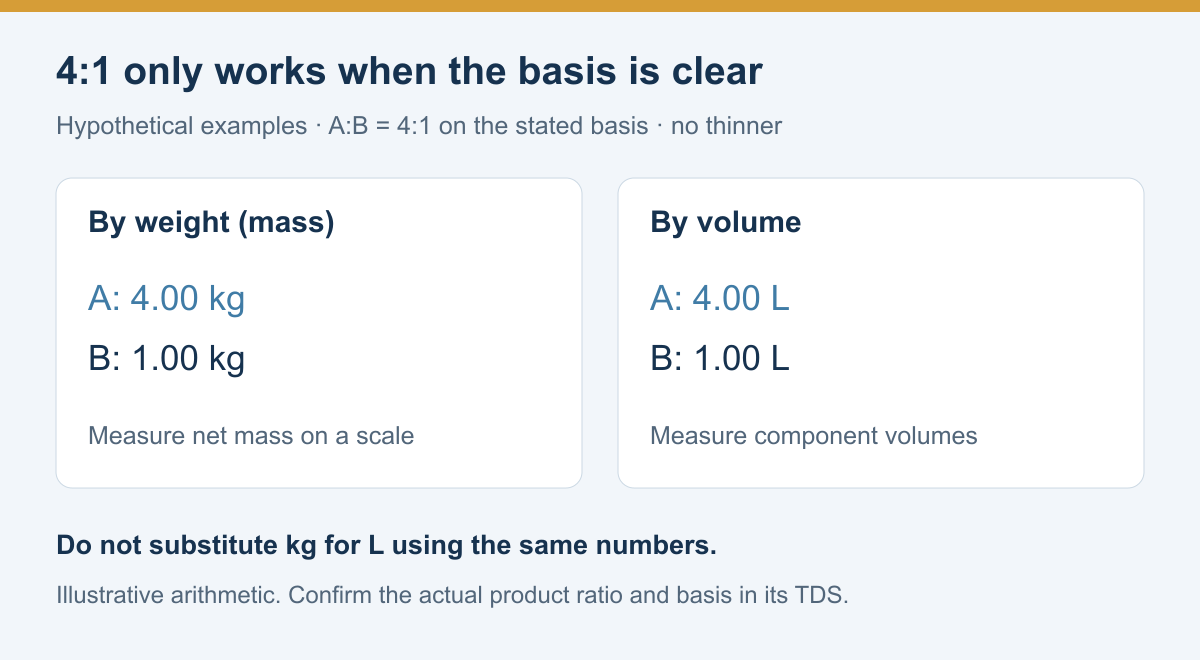
Illustrative calculation only. The two examples show different measurement bases and do not establish a product mixing ratio.
Can a volume ratio be converted to a weight ratio?
Mathematically, yes, using the separate component densities at the applicable conditions. Operationally, use a manufacturer-approved ratio and procedure. A density for the mixed coating does not identify both component densities. Hempel's explanatory notes distinguish mixed-product specific gravity from individual-component data.
For a volume ratio A:B = a:b:
Mass ratio A:B = (a × density of A):(b × density of B).
Consider a separate hypothetical example: 4:1 by volume, density A = 1.50 kg/L, and density B = 1.00 kg/L. Measuring 4.00 L of A and 1.00 L of B gives 6.00 kg of A and 1.00 kg of B. The corresponding mass ratio is 6:1, not 4:1. The assumed densities are teaching inputs, not measured JD specifications.
Conversely, divide each mass-ratio part by its component density to obtain a volume ratio. Keep units consistent. If either density or the ratio basis is uncertain, stop the conversion and request confirmation. Do not work backward from the mixed density to invent missing inputs.
Prepare and mix according to the product instructions
Hempel's mixing guideline favors complete kits where possible and describes stirring individual components, combining them, and mixing to homogeneity. Its instructions apply to Hempel products; use them as general context, then follow the exact JD product's instructions.
For a marine coating work instruction, specify:
- Document and kit checks. Match the component identities, kit sizes, shelf-life information, and current TDS. Obtain the applicable component SDS and required workplace controls before site work.
- Premixing. Follow the stated procedure for redistributing settled material in individual components. Measuring from an unmixed, settled component can undermine an otherwise correct calculation.
- Metering and transfer. Use the approved basis and equipment. Transfer the required component quantity, including material retained in the source vessel as the procedure requires.
- Mixing. Follow the specified equipment and duration. Scrape accessible walls, corners, and the bottom as directed. Uniform color is a useful observation, but does not verify the measured ratio.
- Time control. Record when the components first meet. Observe any specified induction time and pot life at the actual conditions. Keep detailed batch scheduling in the work plan.
Do not add extra curing agent to accelerate curing. WEST SYSTEM's dispensing guidance explicitly advises maintaining the correct ratio and thorough mixing. Its resin-system ratios, pump settings, and mixing times must not be transferred to a JD coating. Treat approved thinner as a separate addition governed by the product instructions; it is not another way to correct A:B proportions.
Use a batch record that another person can check
The following is a blank recording template, not a completed inspection or an acceptance specification. Add the manufacturer's tolerances and the project's sign-off requirements before use.
| Record field | Entry to retain |
|---|---|
| Product and components | Exact A and B codes, batch numbers, matched kit identification |
| Governing document | TDS revision; explicit ratio and basis; partial-kit authorization if relevant |
| Planned quantities | A and B targets with kg or L clearly stated |
| Actual quantities | Separate net additions of A and B; container tare where relevant |
| Measuring equipment | Equipment ID and accuracy/calibration check required by the procedure |
| Mixing and conditions | Operator, material temperature, mixing method, start time, induction and use-by time from approved instructions |
| Other additions | Approved thinner identity, quantity, and basis, or “none” |
| Disposition | Coating area/batch reference, release or hold, and reviewer |
Hold the batch if the component identity, ratio basis, individual quantities, or document instruction cannot be verified. Record the uncertainty and seek the manufacturer's disposition. Do not guess a top-up quantity from how the mixture looks or apply a suspect batch to keep work moving.
Frequently asked questions
Does 4:1 mean 20% hardener?
For a hypothetical A:B = 4:1 on one consistent basis, B is 20% of the total A+B and 25% of A alone. Always name the denominator. A percentage without a basis can cause a different batch to be prepared.
Can I split a factory kit in half?
Only when the manufacturer's instructions permit partial mixing and define the measurement basis and procedure. Half a can by eye is not a measurement. Check whether a smaller matched kit would suit the work better.
Can I correct an uncertain ratio after mixing?
Do not estimate a correction. Hold the batch and provide the actual recorded additions to the manufacturer. A verified weighing or recording issue needs a documented disposition; apparent consistency or color cannot establish the proportions.
Ask JD Marine Paint to confirm the mixing instructions
For a marine epoxy coating inquiry, send the exact product code, photographs of both component labels, the TDS revision, intended batch size, and proposed measuring equipment. Identify whether the question concerns a full kit, a partial kit, or conversion between bases. Request confirmation of the ratio basis and current TDS/SDS before preparing the production batch.