A dust tape test assesses dust remaining on a prepared steel surface by collecting particles with pressure-sensitive tape and evaluating quantity and particle size using the specified references. Record both assessments, link the sample to its location, and compare it with the project's acceptance criterion before releasing the area for coating. A tape strip or photograph without that context does not establish that the surface is ready for primer.
For shipyards and coating contractors, the practical task is to connect each observation to the surface that will be painted. This guide explains that record and review process. Use the approved test procedure and current kit instructions for the actual sampling technique.
What does the dust tape test assess?
The official ISO 8502-3:2017 description identifies a qualitative assessment of dust on cleaned steel prepared for painting. It distinguishes pictorial ratings for average dust quantity from descriptive classes for average particle size. The ISO catalog lists this edition as current, confirmed in 2022, and describes the method as useful for steel whose condition before cleaning corresponds to rust grade A, B or C under ISO 8501-1.
Check that this scope fits the surface and contract. Where the substrate, initial condition or accessibility raises a question, resolve method suitability before presenting a result as compliant. The approved procedure must also establish the sampling plan and required reference material.
Do not convert a qualitative dust rating into a mass-per-area result. Keep the method's original reporting terms instead of adding units that suggest a different test was performed.
Keep surface dust separate from other checks
Dust assessment answers one preparation question. A clean-looking tape does not measure soluble salts, prove that the compressed-air supply is free of oil or water, or test adhesion of a cured coating.
Use separate records for soluble salt testing and the compressed-air blotter test. Link their area and equipment identifiers where relevant, so the pre-coating review can find all required evidence. Do not treat one acceptable result as a replacement for the other inspections in the work pack.
The Elcometer 142 product page describes equipment for assessing dust quantity and size and retaining a record. Its explanation also identifies the adhesion and finish concerns associated with dust on blast-cleaned surfaces. Those concerns justify a defined check; they do not supply a universal acceptance class for every marine coating.
Agree the test basis before collecting samples
Put the applicable documents and decision authority in the inspection work pack. The following editorial checklist helps a contractor and inspector agree what the report must contain. It is not a replacement for the standard or kit procedure.
| Planning item | Agree before testing | Retain with the report |
|---|---|---|
| Area identity | Drawing, compartment and prepared-surface boundaries | Location map and area ID |
| Method | Standard edition, approved procedure and suitable kit | Document revisions and kit identification |
| Sampling coverage | Required locations, number of samples and treatment of inaccessible areas | Actual sample map and any coverage gaps |
| Assessment | Correct quantity reference and particle-size classification basis | Both reported assessments and reference identity |
| Acceptance | Project criterion, applicable coating/system and release authority | Criterion reference and signed decision |
If an instruction says only “dust test passed,” ask what observations and criterion support that statement. If it specifies only one assessment field, clarify how the other result is to be reported. Resolving these points before inspection prevents a later disagreement over what the contractor actually demonstrated.
Protect the sample-to-location connection
Elcometer's published operating instructions describe handling the tape by its ends, collecting the sample, using the supplied display arrangement to assess quantity, assessing particle size with the stated reference, and retaining strips on the test record. They also require removal of tape or adhesive residues before painting. Follow the complete applicable instructions for tape handling, contact technique, repeat tests and assessment conditions; this overview omits those procedural settings.
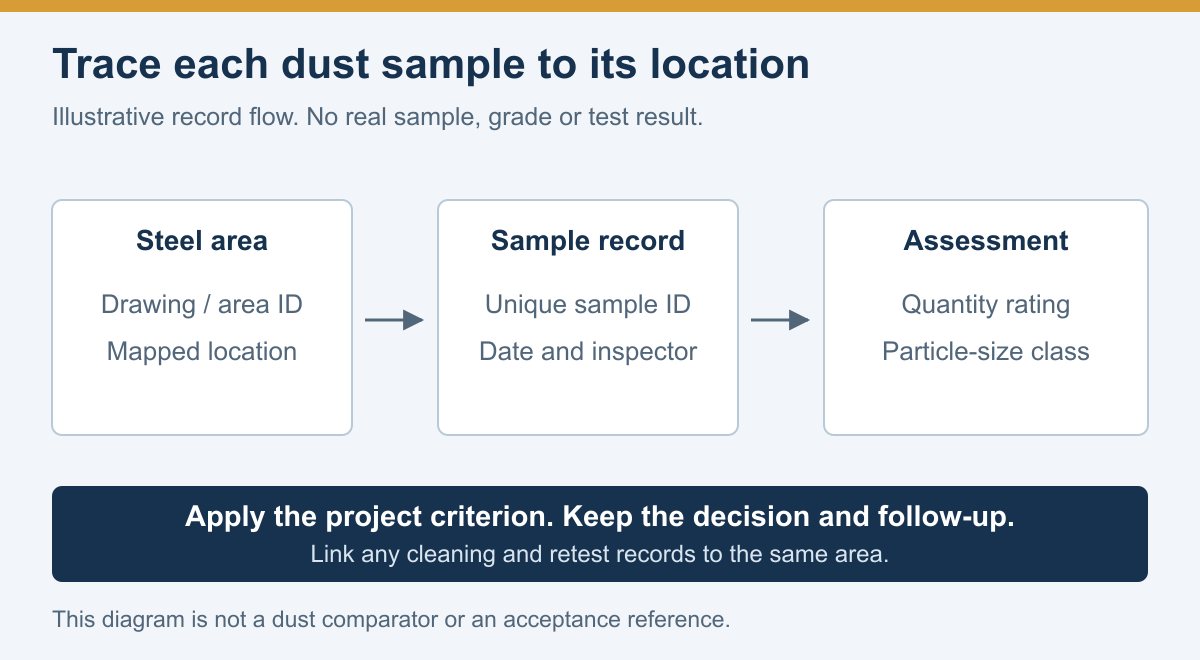
Arrange sample identification before going to the work area. For example, a project may use a compartment identifier plus a location and sample sequence. Choose an identifier that matches the drawing and field sheet, rather than relying on a photograph's file order.
Record the prepared surface's status when sampling occurs. If further cleaning, access work or other activity follows, keep that history attached to the area record. The reviewer then has a basis for deciding whether existing observations still support the planned coating operation or whether the agreed procedure calls for another check.
Record quantity and particle size separately
Use separate fields with the same sample ID. Do not collapse quantity and size into an undocumented “dust score,” add their codes together, or silently replace one with the other. Preserve the original observations if a review later changes the decision.
The blank structure below is an editorial report aid. Populate actual results from the approved assessment; no example pass result or reference-grade photograph is supplied here.
| Record group | Fields to complete | Evidence link |
|---|---|---|
| Work area | Project, drawing, compartment, location and surface condition | Inspection map |
| Test basis | Procedure/standard revision, kit and reference identification | Controlled work-pack references |
| Sample | Unique ID, collection date/time and inspector | Retained strip or approved sample record |
| Assessment | Quantity rating and particle-size class in separate fields | Identified sample and assessment notes |
| Decision | Criterion, comparison result and authorized reviewer | Release or hold record |
| Follow-up | Cleaning action, retest sample IDs and closure date | Linked corrective-action and retest records |
Where photographs supplement the record, label the sample and location and retain the assessment context. An enlarged phone image with unknown lighting, scale or background should not become a homemade substitute for the specified reference material. The illustration in this article shows record relationships only.
Handle an adverse or uncertain observation
Before authorizing primer application, resolve any missing criterion, uncertain assessment or incomplete coverage. Use a documented action that identifies the affected area and the person responsible for closing the issue.
| Situation | Coordination action | Closure evidence |
|---|---|---|
| Observation does not meet the criterion | Hold the identified area and arrange the approved cleaning action | Cleaning record and required retest |
| Reference or sample identity is uncertain | Review the record before claiming a valid assessment | Correct identification or a replacement test as directed |
| Required locations were inaccessible | Escalate the coverage gap under the inspection plan | Access/reinspection record or authorized disposition |
| Work continues after the test | Review the intervening activity and surface condition | Confirmation of the applicable recheck/release requirements |
Keep the original result, corrective action and retest as linked records. Replacing an adverse entry with a later acceptable one hides the route to release. Conversely, a single uncertain sample should not be described as proof that the entire vessel has the same condition; define the inspection lot and extent of follow-up through the approved plan.
Confirm the requirements for the actual JD primer
The current JD marine epoxy primer range provides product and preparation documents. Its surface-preparation planning guide discusses contaminant removal and preparation to the project specification. The linked JDH815 public sheet does not establish a dust quantity/size acceptance criterion for every project.
Request the controlled current TDS, component SDS and system-specific preparation requirements for the proposed work. No JD dust acceptance class, test interval or product certification is assigned by this article. Keep the dust assessment within the wider substrate-release process before primer application.
Frequently asked questions
Is this the same as a paint adhesion tape test?
No. This article concerns dust collected from prepared steel before painting. An adhesion test addresses a coating's attachment using its own method and reporting requirements.
Can a dust result be reported in mg/m²?
The qualitative tape assessment described here reports quantity and particle-size assessments. A mass-per-area figure would require an applicable measurement method and evidence; do not derive one from a visual rating.
What dust class is acceptable before marine epoxy primer?
Use the criterion specified for the project and coating system. If it is missing, obtain clarification before declaring the area acceptable.
Request a surface-release document review
Preparing a blasting-to-primer handover? Contact JD Marine Paint with the steel condition, exact primer/system, preparation method, specified dust criterion, sample map and quantity/size records. Identify any held or untested areas so the document review can address the remaining release decisions.