Epoxy pot life is the usable period after the components are mixed, under the manufacturer's stated conditions. Induction time is a specified waiting period before application. Do not add induction time to the end of pot life. Confirm the product's clock definition, record when the components first meet, and plan mixing, waiting, transfer and application within the permitted period.
For a shipyard crew, the practical question is how much mixed paint can pass through the equipment before its deadline. A batch schedule makes that decision visible before a container is opened.
Separate the four coating clocks
| Term | What it controls | Planning consequence |
|---|---|---|
| Induction time, sometimes called sweat-in | Any prescribed wait between mixing and application | Follow the product's sequence and temperature conditions; some products or conditions require no wait. |
| Pot life | How long the mixed material remains usable under stated conditions | Establish a use-by time for each batch, including material in the application equipment. |
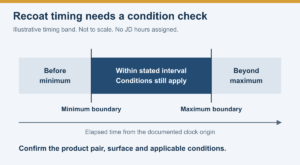
| Recoat interval | When another coat may be applied, including any maximum interval | Record coating completion and the required surface condition separately. |
| Full cure / readiness for service | The manufacturer's specified cured state or release condition | Confirm the requirement for the actual exposure; touch-dry paint is not evidence of immersion readiness. |
Hempel's explanatory notes distinguish pot life from drying and overcoating stages. Their definitions concern Hempel products; the actual JD product documents govern JD coating work.
Do not assume a standard induction period. For example, the current Hempadur Mastic 45880 data sheet lists induction by product temperature and separate spray and brush pot lives. That illustrates why the conditions matter; those values are not JD application instructions.
Read the conditions behind a pot-life number
Before releasing a batch, obtain the current product-specific TDS, application instructions, component SDS and project specification. Record:
- Exact base and curing-agent codes, document revision and approved application method.
- Material temperature and the relevant pot-life value, rather than air temperature alone.
- The manufacturer's start point, induction sequence and any method-specific use limit.
- Test mass or volume and container conditions, if supplied; ask when the field batch differs materially.
- Permitted batch sizes, kit-splitting rules and any approved temperature-conditioning procedure.
Steel temperature, humidity and condensation controls remain separate application checks. A valid batch clock does not release an unsuitable surface. See the marine primer application and troubleshooting guide for the wider inspection sequence.
What the public JDH815 documents establish
The public JDH815 Iron Oxide Red Epoxy Primer sheet states a pot life of 4 hours at 25°C (77°F). It does not state a test batch mass, container geometry or induction period. The July 2026 primer catalog summary repeats that figure and requires current product-specific verification for contractual work.
These public documents do not establish four hours for another product, hotter paint or every application method. No current component SDS was available from the reviewed product and category download links. Request the controlled documents and clarification of missing timing conditions before site use; do not interpret an omitted induction value as confirmed zero.
Match batch size to the crew's real work rate
Use a measured, conservative rate of mixed-material consumption for the actual task. Straight, accessible plating and interrupted work around brackets can consume paint at different rates. Include expected pauses for access, inspections and equipment adjustment.
Hempel's mixing guideline recommends preparing only what can be used within pot life and notes that the mixture can warm as curing begins. WEST SYSTEM's mixing guidance explains how concentrated epoxy batches retain reaction heat. Its resin-specific handling methods are not a substitute for a marine coating's instructions.
Ask the coating supplier to confirm suitable batch and container conditions. Transferring paint into a tray, hose or another pot does not create a new batch clock. Do not assume that a smaller container provides a quantified extension, or apply a universal temperature-halving rule to an unverified product.
For ratio measurement and partial-kit authorization, use the separate epoxy mixing ratio guide. Time planning cannot correct an inaccurate ratio.
Worked example: build a batch schedule before mixing
All values below are hypothetical planning inputs, not JD product instructions or a tested production rate. Assume the supplier has confirmed a 120-minute use period starting at first component contact for the specified material temperature and equipment. Also assume a five-minute mixing stage, a subsequent ten-minute induction, five minutes for transfer/setup, and a ten-minute scheduling reserve.
The assumed net draw rate is 0.10 L/min of usable mixed coating, including equipment-related consumption. Volumes exclude added thinner; rate and batch volume use the same basis.
Planned application time = 120 − 5 − 10 − 5 − 10 = 90 minutes.
Time-based quantity ceiling = 90 min × 0.10 L/min = 9.0 L.
This ceiling screens scheduling feasibility; it does not authorize a batch size or split kit. Assume an approved, complete matched kit yields 8.0 L. Its estimated application duration is 8.0 ÷ 0.10 = 80 minutes.
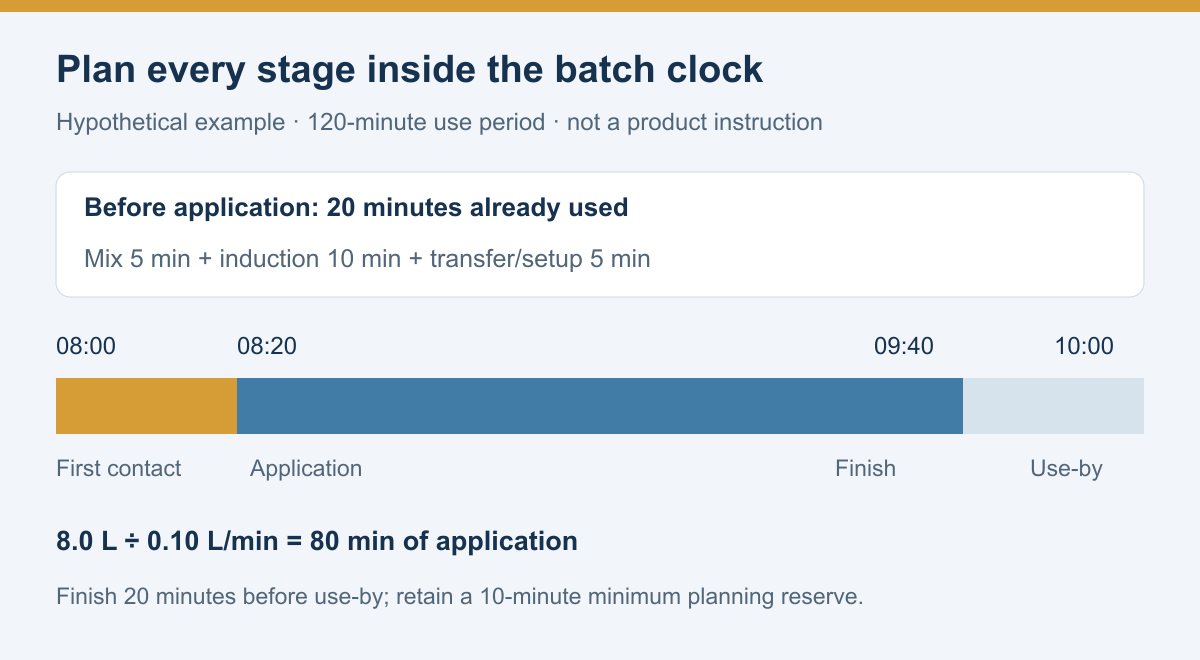
Illustrative timing only. Induction, mixing and transfer consume time within the assumed 120-minute period.
| Milestone | Example time | Reason |
|---|---|---|
| Components first meet | 08:00 | Start the assumed 120-minute clock. |
| Mixing completed | 08:05 | Five assumed minutes consumed. |
| Required induction completed | 08:15 | Another ten minutes consumed. |
| Application starts | 08:20 | Five transfer/setup minutes consumed. |
| Planned 8.0 L batch finish | 09:40 | Eighty minutes of assumed material draw. |
| Planned latest finish | 09:50 | Retain the ten-minute scheduling reserve. |
| Technical use-by deadline | 10:00 | Do not continue applying remaining mixed material. |
If the draw rate falls to 0.08 L/min, the same kit needs 100 minutes and finishes at 10:00, losing the reserve. Revise the plan before mixing: select a supplier-approved smaller kit, change the work arrangement, or obtain an approved alternative. Never change the component ratio to gain time.
Keep one record for every mixed batch
This blank record is an editorial planning aid, not a completed inspection certificate.
| Field | Information to enter |
|---|---|
| Identification | Batch ID; product/component codes; lot numbers; operator; vessel area |
| Document basis | TDS/application-instruction revision; timing definition; supplier clarification |
| Conditions | Material, air and steel temperatures; required environmental checks |
| Quantity | Approved kit size or authorized partial batch; measurement basis; permitted thinner, if any |
| Clock | First contact; mixing completion; induction start/end; calculated use-by |
| Work plan | Transfer time; expected draw rate; planned finish; reserve; equipment hold-up |
| Actual outcome | Application start/finish; interruptions; unused quantity; disposition; reviewer |
Keep batch identities separate at crew handovers. Do not top up an aging mixture with fresh material or reset its label after a break. Check the equipment manufacturer's cleaning procedure so mixed residues are managed before their applicable limit.
Stop on time, even if the mixture still looks fluid
Appearance is not a release test. Stop using material at its documented limit, or earlier if it no longer meets application requirements. Hempel's explanatory notes specifically state that thinning does not extend pot life. Adding solvent is not a way to restart the reaction clock.
Segregate unusable mixed coating and follow the applicable SDS, site procedure and waste rules. Unexpected heating or other abnormal behavior requires the site's response procedure. This schedule is not a hot-batch handling or disposal instruction.
Frequently asked questions
Does induction time extend epoxy pot life?
Do not add it as extra time. Follow the manufacturer's stated start point and sequence. In the worked example, the clock starts at first contact, so mixing, induction and transfer all reduce the remaining application window.
Can I use a four-hour pot life at any temperature?
No. Keep the stated product and temperature attached to the figure. Ask for the applicable value when material temperature, batch conditions or application method differs; do not invent an adjustment factor.
Is full cure the same as being ready to recoat?
No. Recoat timing governs the next coating operation. Service release concerns the intended exposure. Verify both requirements independently in the approved system documents.
Request a project-specific batch-planning review
When selecting from the marine epoxy coating range, send the product code, proposed kit size, material and steel temperatures, equipment, expected draw rate and access constraints. Contact JD Marine Paint to request current TDS/SDS and clarify timing before finalizing the crew's batch plan.