Stripe coating is a localized application of coating to edges, welds and difficult steel geometry where a full spray coat may not provide uniform coverage. It supplements the specified full coats. The product, locations, application sequence, stripe width, film-build limits and number of stripe coats must come from the approved coating system and project specification.
For shipyard supervisors and coating inspectors, the useful deliverable is a traceable map of treated details. A photograph of a painted weld alone cannot show that preparation, thickness and recoating requirements were met.
Identify the details before the painter starts
Hempel's stripe-coating guideline, still linked from its technical-guideline library when checked, describes this work as reinforcement of irregular and hard-to-reach areas, commonly applied by brush. It is general Hempel guidance, not a JD product instruction.
Walk the structure with the drawing and create a location list. The following is an editorial inspection aid, not a specification assigning treatment to every component.
| Detail to review | Question for the work pack | Evidence to record |
|---|---|---|
| Plate edges and cut-outs | Are all faces and the edge transition included in the approved detail? | Drawing reference and identified edge length/location |
| Welds and intersections | Can the operator reach both sides and the weld profile? | Weld reference, preparation release and close-up |
| Stiffener backs and brackets | Is the concealed face accessible for application and checking? | Access arrangement and reverse-side image |
| Scallops, openings and fittings | Which recesses need individual treatment? | Marked overview showing the complete local geometry |
| Pitted repair areas | Has the substrate condition been accepted before coating? | Repair reference and acceptance record |
Include inaccessible areas in the planning discussion. Do not let an unchecked surface disappear from the record because the surrounding plate is finished.
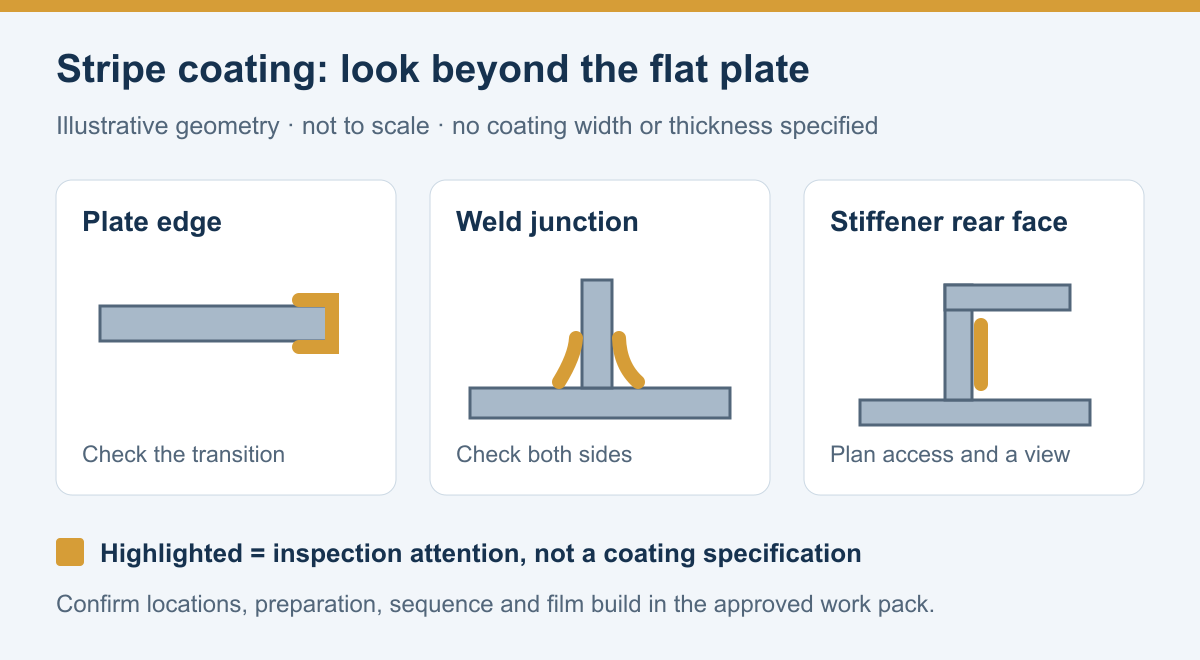
Schematic only, not to scale. Highlighted areas identify inspection attention; they do not specify stripe width, coating thickness or a treatment sequence.
Release preparation before covering it
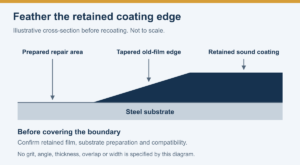
Stripe coating does not replace steel finishing or surface cleaning. Hempel's stripe guideline calls for removal of sharp irregularities and weld debris before painting. Agree the required weld finish and edge treatment with the responsible steelwork and coating teams; do not use a generic edge-radius number without its applicable specification.
The JD marine epoxy primer preparation summary, revision 2026.07, calls for substrate assessment, contaminant control and attention to edges, welds and complex geometry. It is a planning summary and directs final requirements to current product documentation.
Use a preparation hold point with these separate questions:
- Has the steelwork been accepted, including any defects requiring repair rather than paint?
- Do cleanliness and surface profile meet the specified method and criterion?
- Are oil, soluble salts, dust and other contamination assessed using the required procedures?
- Are the recorded material and environmental conditions within the approved application limits?
- Is the surface still acceptable immediately before application, after any access or weather delay?
Hempel's inspection-before-painting guide treats these as distinct checks. A clean-looking surface is not a measurement of invisible salt contamination. Keep detailed preparation instructions in the marine primer application and troubleshooting guide, rather than substituting this checklist for them.
Agree the stripe and full-coat sequence
Write the sequence into the work pack before mixing. The Penguard EXA II application guide, issued 7 April 2026, illustrates why there is no single sequence for every job: its guidance includes stripe-before-full-coat and full-coat-before-stripe arrangements, with conditions. Those are Jotun instructions and cannot authorize a JD sequence.
For the proposed JD system, obtain written confirmation of:
- Which coating layers require stripes, and where each stripe begins and ends.
- Whether each stripe precedes or follows its associated full coat.
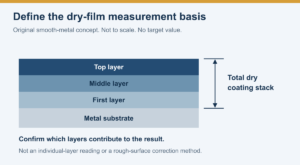
- The permitted application method, stripe extent and per-layer/total film-build limits.
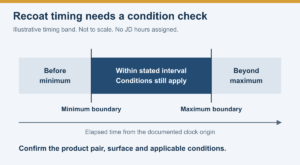
- Minimum and maximum recoating conditions, including any wet-on-wet permission.
- Inspection stages, access needs and responsibility for releasing the next operation.
Hempel's stripe guideline also warns against excessive buildup in corners. More paint is not automatically a better result. At overlapping details, assess the combined system build instead of treating every brush pass as an isolated operation.
Match the product to the approved system
Start with the marine epoxy primer range, then verify the selected product and service area. The public JDH815 product sheet lists brush application among its methods, but does not establish a complete stripe-coating procedure, stripe width or coat count.
The July 2026 primer catalog summary explicitly requires current product-specific TDS, SDS and project verification. No current component SDS was found in the reviewed public product/category downloads. Request those documents before site work. Do not convert a general application-method listing into tank-system approval.
Inspect during application and before covering the detail
The following checks organize observation and follow-up; the approved inspection plan supplies acceptance values and repair instructions.
| Check | What the inspector should establish | Follow-up when uncertain |
|---|---|---|
| Location coverage | Every listed detail, including hidden faces, has been addressed. | Reopen the location list and arrange access. |
| Film condition | Look for misses, exposed substrate, runs, pronounced ridges and trapped debris. | Identify the defect and refer to the approved repair procedure. |
| Local buildup | Stripe intersections and corners remain within the applicable film-build requirements. | Obtain measurements or supplier review using the specified method. |
| Thickness evidence | Gauge, verification, measurement locations and acceptance basis are documented. | Resolve unsuitable geometry or inconsistent readings with the inspector/supplier. |
| Recoat release | Time, temperature, surface condition and any required preparation are acceptable. | Hold the next operation until requirements are resolved. |
| Repairs | Each marked issue has a repair and reinspection record. | Keep the item open until the named reviewer closes it. |
The Jotun guide specifies how its weld-adjacent thickness checks are made. Do not transfer that measurement distance into a universal rule. Agree an appropriate method for the actual edge or weld geometry. Use the wet-film-thickness guide for the separate relationship between wet and dry film measurements.
Hempel's testing-after-painting guideline explains that additional tests must be specified with their methods, acceptance criteria and repair provisions. A passing local test does not erase inadequate preparation elsewhere. Do not add an improvised holiday-test voltage or a destructive test to this checklist.
Keep photographs linked to inspection results
Use the following blank record as a handover aid. It contains no measured project results.
| Record field | Information to enter |
|---|---|
| Location and stage | Vessel/structure, zone, drawing/detail ID and stripe/full-coat stage |
| Document basis | Approved system, product, specification revision and inspection-plan reference |
| Preparation release | Steelwork acceptance and referenced cleanliness/profile/contamination records |
| Application | Product/component lot numbers, batch reference, operator and start/finish times |
| Conditions | Required environmental and material readings, with time and units |
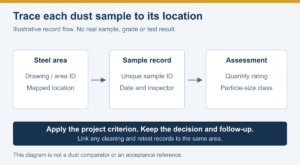
| Images | Overview, close-up and reverse-side photo IDs linked to the same location |
| Acceptance | Visual findings, thickness record/method, repair reference and reviewer/date |
Illustrative record format: a photo ID such as “Zone-A / Detail-01 / Before” identifies a view; it is not evidence that Detail-01 passed. Keep “not inspected,” “repair required” and “accepted” as separate outcomes, with a named reviewer and the actual criteria recorded.
Keep tank requirements within their proper scope
For a ballast-tank coating project, verify the applicable approved system, project requirements and coating records. The Jotun guide separates its general advice from a PSPC appendix; its numerical requirements are not generic instructions for all marine steel or JD products.
Potable-water tanks also require their own product and service acceptance. Refer to the existing potable-water tank application guide for that broader workflow. This article does not select a tank lining or establish regulatory compliance.
Frequently asked questions
Is stripe coating a substitute for a full coat?
No. It reinforces identified details as part of the specified system. Record and complete the associated full coats separately.
Should the stripe coat always go on first?
Follow the approved sequence. Manufacturer guides can allow different arrangements under stated conditions; do not choose one from habit or from another product's guide.
How many stripe coats are required?
Use the applicable system and project specification. There is no coat count in this general checklist that applies to every vessel area, product or exposure.
Request an application and inspection review
Send JD Marine Paint your project details: service area, steel/weld condition, proposed coating system, access photographs and inspection specification. Ask for current TDS/SDS and confirmation of stripe locations, sequence, film-build criteria and recoat requirements before releasing the work pack.