Calculate marine paint consumption separately for every coating layer: theoretical liters = area × dry film thickness ÷ (1,000 × volume-solids fraction). Use area in m², dry film thickness (DFT) in µm, and a fraction such as 0.65 for 65% volume solids. Then apply a clearly defined practical-consumption adjustment and round each product to complete kits only after its usable mixed volume per kit is confirmed.
This produces a quantity estimate, not approval of the coating system. Shipyard estimators and distributors should keep product selection, application requirements and purchasing quantities connected to the same revision of the work scope.
Collect inputs for each layer
| Input | What to establish | Frequent estimating error |
|---|---|---|
| Coated area, m² | Actual surfaces included in this layer, including relevant faces of structures | Using one projected area without checking hidden or reverse faces |
| Product and shade | Exact coating/component codes and current technical data sheet (TDS) | Treating every epoxy product as having identical solids |
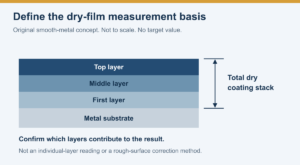
| DFT, µm | Specified thickness for this coat, and the required coat count | Using total-system thickness for every coat |
| Volume solids | Applicable mixed-product value on the stated basis | Substituting solids by weight |
| Practical adjustment | Defined efficiency or consumption factor supported by the proposed method and scope | Applying two adjustments for the same loss |
| Procurement unit | Confirmed usable mixed liters per complete kit | Treating kilograms or container capacity as liters of paint |
Separate new coating, repairs and local reinforcement where their coverage differs. Keep the drawing or area-takeoff revision with the estimate so another estimator can reproduce it.
Calculate theoretical spreading rate and liters
For a smooth, non-absorbing surface with no application loss:
Theoretical spreading rate, m²/L = 1,000 × volume-solids fraction ÷ DFT in µm.
Theoretical quantity, L = area in m² ÷ theoretical spreading rate.
If solids are entered as a percentage number, the equivalent rate is 10 × volume solids (%) ÷ DFT. These relationships are set out in Hempel's explanatory notes to product data sheets. Do not enter 65 in the fraction-based equation; enter 0.65.
Check a published product figure without turning it into a quotation
The public JDH815 Iron Oxide Red Epoxy Primer sheet lists 65% volume solids, 70 µm DFT and 9.3 m²/L theoretical coverage. Recalculating gives 1,000 × 0.65 ÷ 70 = 9.286 m²/L, which rounds to the listed value. An assumed 100 m² at those inputs requires 10.77 L theoretically, before practical adjustments.
This checks arithmetic from the public sheet; it does not establish a current contractual requirement or field consumption. The July 2026 primer summary requires current product-specific TDS/SDS and project verification. No current component SDS was identified in the reviewed public product/category downloads. Request the controlled documents before finalizing site instructions or a purchase.
Define efficiency and allowance before calculating losses
Hempel's consumption calculator distinguishes theoretical quantity from practical consumption through a consumption factor. Its explanation identifies film variation, geometry, roughness and physical losses as project-dependent contributors. It does not supply a universal factor for a JD project.
For this worksheet, define effective application efficiency, η = theoretical quantity ÷ practical quantity, with 0 < η ≤ 1. This is an estimating ratio encompassing the adjustments included in the model, not a measured spray-gun transfer efficiency. Then:
Practical quantity = theoretical quantity ÷ η.
Equivalently, the consumption factor is CF = 1 ÷ η, and practical quantity equals theoretical quantity × CF. State which effects your chosen ratio covers; additional roughness or overbuild allowances must not silently duplicate them.
A loss percentage is different from an added allowance
Illustrative arithmetic only: for 100 L theoretically, an assumed 75% effective efficiency gives 100 ÷ 0.75 = 133.33 L. In this model, the 25% shortfall is a fraction of practical quantity, not an instruction to add 25% to theoretical quantity.
An added allowance of 25% instead gives 100 × 1.25 = 125 L, equivalent to 80% efficiency. The two estimates differ by 8.33 L. An estimate labeled only “25% waste” is therefore ambiguous: write its denominator and formula into the work pack.
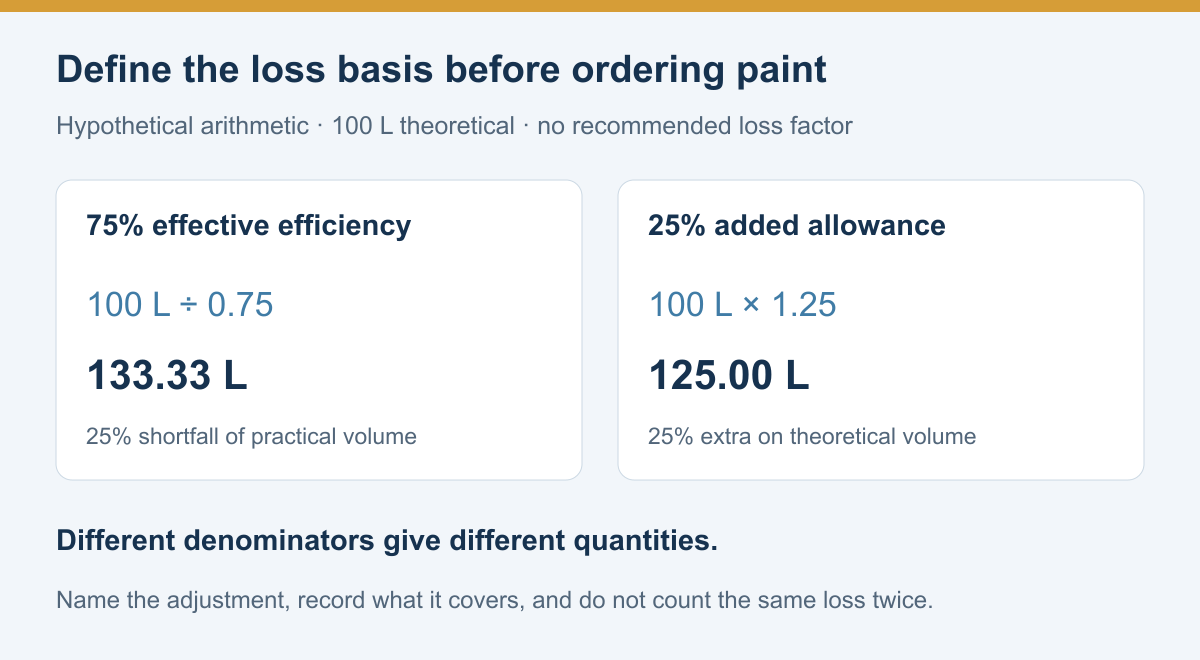
Illustrative quantities, not recommended loss factors. Choose one defined adjustment basis for each modeled effect.
Worked example: primer, intermediate and topcoat
All inputs in this table are hypothetical teaching assumptions. The layers do not represent an approved JD coating system, product specifications or measured shipyard efficiency. Each layer covers an assumed 600 m² once, with no added thinner and no separate local-reinforcement quantity.
| Assumed layer | DFT, µm | Volume solids | Theoretical rate, m²/L | Theoretical L | Assumed η | Practical L |
|---|---|---|---|---|---|---|
| Primer | 75 | 60% | 8.00 | 75.00 | 75% | 100.00 |
| Intermediate | 125 | 75% | 6.00 | 100.00 | 80% | 125.00 |
| Topcoat | 50 | 50% | 10.00 | 60.00 | 75% | 80.00 |
| Total, before kit rounding | — | — | — | 235.00 | — | 305.00 |
Primer calculation: 600 × 75 ÷ (1,000 × 0.60) = 75 L theoretically; 75 ÷ 0.75 = 100 L practically. Calculate the other products independently, then sum liters only for a logistics overview. They remain separate purchasing lines.
If a layer requires two identical coats over the same area, calculate both applications. If their thicknesses or covered areas differ, use separate rows. Do not multiply again by coat count after already entering each coat separately.
State what the estimate includes
| Item | Treatment in the example | What to confirm for a real project |
|---|---|---|
| Main coated area | Included once per assumed layer | Takeoff method and each layer's actual coverage |
| Routine practical consumption | Included through each assumed η | Which physical losses, roughness and film variation the factor covers |
| Stripe coats and local repairs | Excluded as separate quantities | Estimate their additional work without counting it twice |
| Extra project reserve | Not added | Define its purpose separately from application loss |
| Thinner and equipment cleaner | Excluded | List approved materials separately; neither replaces coating solids |
For a specified DFT, adding thinner does not create more coating solids. Keep the estimate in the original mixed-coating basis and list permitted thinner separately. Use the wet-film-thickness calculation guide when planning application checks.
Round purchasing quantities to verified complete kits
For each product, once the supplier confirms usable mixed liters per complete kit:
Kits to order = round up (required procurement liters ÷ confirmed mixed liters per kit).
Use procurement liters after any separately approved reserve. Document the resulting purchased volume and rounding surplus. Round each product individually; a surplus of topcoat cannot replace a shortage of primer.
The public JDH815 sheet lists Part A at 25 kg and Part B at 3 kg. Those are component masses, not a verified 28 L kit. This article therefore does not assign numerical kit counts to the three hypothetical products. Obtain the current supply format and confirmed mixed-volume basis first; container size and component mass are insufficient substitutes.
For metering and ratio questions, use the epoxy mixing-ratio guide. Keep prices, labor and docking charges in the separate marine paint project-cost guide.
Compare planned and actual consumption on the same basis
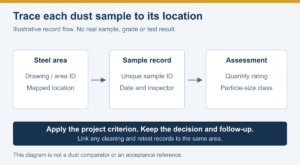
Keep a per-product record of area completed, specified and measured DFT, issued quantity, usable returns, transfers, discarded mixture and repair work. Record liters consistently; convert kits or mass only using an established product-specific basis.
For a closed work package with no starting stock or inter-zone transfers, net consumption equals issued volume minus usable returned volume. Otherwise reconcile opening/closing stocks and transfers as well. Expired mixed material is not a usable return.
Compare that result with the same completed area and coating scope used in the estimate. Higher consumption alone does not prove excessive spray loss: changed scope, additional repairs, film build and inventory movements may also explain it. Record the cause before changing the next project's efficiency assumption.
Frequently asked questions
Can I use solids by weight in this formula?
No. The calculation requires volume solids on the applicable product basis. A weight-solids percentage is not interchangeable with it.
Can I use one coverage rate for the whole coating system?
Calculate each product and coat separately. Solids, DFT and area may differ, even when all products are described as marine coatings.
Should I add a loss allowance after using practical spreading rate?
First establish what that practical rate already includes. Adding another factor for the same loss counts it twice. Keep any genuinely additional reserve separately identified.
Request a project quantity review
Send the area takeoff by vessel section, proposed products, per-coat DFT, application method, adjustment assumptions and required supply format. Contact JD Marine Paint to request current TDS/SDS and a quantity check for the marine epoxy primer and marine epoxy coating options under consideration.