Marine primers for corrosion control should be selected as part of a complete coating system, not by primer price or resin name alone. Fleet managers, shipyards, coating contractors, and procurement teams need to balance substrate condition, surface-preparation capability, vessel area, service exposure, maintenance interval, application productivity, and inspection requirements.
This B2B guide focuses on steel corrosion-control strategy and lifecycle value. For basic substrate selection, use the marine primer selection guide. For field technique and defect diagnosis, see the marine primer application and troubleshooting guide.
How Marine Corrosion Control Works
Steel corrosion requires metal, moisture, oxygen, and an electrolyte. Marine atmospheres and seawater supply aggressive electrolytes, while welds, edges, damaged areas, and coating holidays create local weak points. A successful coating system interrupts the process through one or more mechanisms:
- Barrier protection: dense films restrict the movement of water, oxygen, and ions.
- Cathodic protection: properly formulated zinc-rich primers can sacrifice zinc to protect blasted steel.
- Inhibitive pigmentation: pigments such as zinc phosphate support corrosion resistance within compatible binder systems.
- System continuity: stripe coats, intermediate coats, and finishes maintain film thickness and protect vulnerable geometry.
Primer Technology Comparison
| Primer family | Typical role | Strengths | Critical limitations |
|---|---|---|---|
| Epoxy zinc-rich primer | First coat on abrasive-blasted steel | Cathodic protection, strong system foundation | Requires correct blast profile, film control, agitation, and compatible overcoating |
| Epoxy zinc-phosphate primer | Anti-corrosive primer beneath epoxy and finish coats | Balanced adhesion, barrier protection, and inhibitive pigmentation | Performance depends on preparation, DFT, and complete system |
| Iron-oxide epoxy primer | General anti-corrosive foundation or maintenance system component | Application practicality and epoxy barrier properties | Not a substitute for zinc-rich protection when zinc is specified |
| Surface-tolerant epoxy | Maintenance on mechanically prepared steel or sound old coating | Useful when full abrasive blasting is impractical | Loose rust, salts, oil, and weak coating still require removal |
| Galvanized-surface primer | Adhesion and protection on zinc-coated steel | Designed for the chemistry of galvanized surfaces | Fresh zinc, zinc salts, and preparation method must be assessed |
Match the System to the Vessel Zone
Underwater Hull
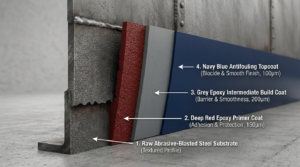
The underwater system must resist immersion, mechanical damage, cathodic-protection effects, and the interface with antifouling paint. A typical direction may include an immersion-rated epoxy primer or barrier coat, additional epoxy thickness, a compatible tie coat, and antifouling. Product compatibility and launch-time requirements must be confirmed.
Boot-Topping and Splash Zone
These areas experience wet-dry cycling, impact, contamination, and strong atmospheric exposure. Edge treatment, stripe coating, adequate barrier thickness, and a finish selected for the exposure are especially important.
Topside and Superstructure
An epoxy anti-corrosive foundation is commonly followed by a compatible UV-resistant finish. The primer protects steel, while the finish provides color, gloss, weathering, and cleanability. Read the epoxy vs polyurethane marine paint comparison for system-role differences.
Ballast Tanks and Internal Spaces
Tank systems require service-specific approval, stripe-coating procedures, ventilation, access planning, film-thickness control, holiday repair, and cure verification. A general exterior primer should not be assumed suitable for tank immersion.
Surface Preparation Is a Commercial Decision
Preparation quality affects both initial cost and service life. Abrasive blasting to the specified cleanliness and profile usually gives high-performance systems the strongest foundation, but access, containment, schedule, and environmental restrictions may limit what is achievable during maintenance.
Procurement should therefore compare complete scenarios rather than product prices:
- Specified preparation standard and realistic production rate.
- Soluble-salt removal and verification.
- Edge preparation, weld repair, and stripe-coat labor.
- Number of coats and total dry-film thickness.
- Application method, overspray, and transfer efficiency.
- Weather window, ventilation, curing time, and dry-dock schedule.
- Inspection, repair, and documentation requirements.
Build a Coating Specification
- Define the asset: substrate, vessel type, zone, existing coating, and repair percentage.
- Define the exposure: immersion, UV, salt spray, abrasion, chemicals, heat, and cleaning regime.
- Set preparation requirements: cleanliness, profile, salts, dust, and edge treatment.
- Select the complete system: primer, stripe coat, intermediate coat, tie coat, and finish.
- Set application limits: temperature, humidity, dew point, pot life, recoat intervals, and curing.
- Set inspection points: hold points, WFT, DFT, adhesion where required, holidays, repairs, and final acceptance.
- Require documentation: current TDS, SDS, batch records, certificates, and inspection reports.
Calculate Lifecycle Value, Not Price per Liter
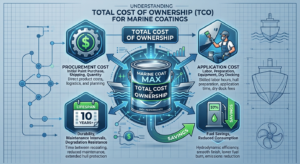
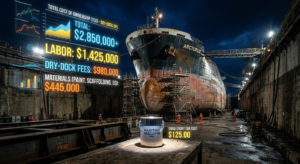
Coating cost includes material, surface preparation, labor, access, containment, inspection, dry-dock time, and off-hire exposure. The lowest material price can be the highest-cost outcome if it needs extra coats, slows production, or fails before the planned maintenance interval.
For comparison, calculate theoretical coverage at the specified DFT, then apply realistic loss factors for roughness, overspray, mixing waste, geometry, and stripe coating. Evaluate the total installed cost per square meter and the expected maintenance interval.
Primer Options for Steel Corrosion Control
- JDH06-4 Epoxy Zinc-Rich Anti-Rust Primer for compatible blasted-steel systems requiring a zinc-rich foundation.
- JDH819 Epoxy Zinc Phosphate Primer for specified epoxy anti-corrosion systems.
- JDH815 Iron Oxide Red Epoxy Primer for compatible general epoxy primer applications.
- JDH818 Rough-Surface Epoxy Primer for suitable maintenance situations with specified mechanical preparation.
- JDH666 High-Build Epoxy Anti-Rust Paint as a compatible barrier-building system component where specified.
Questions to Send a Coating Supplier
- Which surface-preparation standard and profile does the system require?
- What total DFT and number of coats are recommended for the service zone?
- Are the primer, intermediate, tie coat, antifouling, and finish mutually compatible?
- What are the minimum and maximum recoat intervals at expected temperatures?
- What is the curing or immersion schedule?
- Which certificates and test reports are available?
- What repair procedure applies to damage, holidays, and aged coating?
Frequently Asked Questions
Is zinc-rich primer always better?
No. Zinc-rich primers are valuable on correctly prepared steel in compatible systems, but they are sensitive to preparation, film thickness, mixing, and overcoating. Other epoxy primers may be a better fit for maintenance or different service requirements.
Can a surface-tolerant primer be applied over rust?
Only within the limits stated by the product and specification. Loose rust, scale, salts, oil, dust, and weak coating must be removed. Surface tolerant does not mean surface preparation is optional.
How should two primer systems be compared?
Compare required preparation, coverage at specified DFT, number of coats, application productivity, cure time, complete system compatibility, expected maintenance interval, and the cost of downtime.
For a project-specific recommendation and quotation, send the vessel area, substrate, preparation standard, service environment, existing coating, target DFT, application method, schedule, quantity, destination, and certification needs through the JD Marine Paint inquiry form.