What should you check when paint cratering appears?
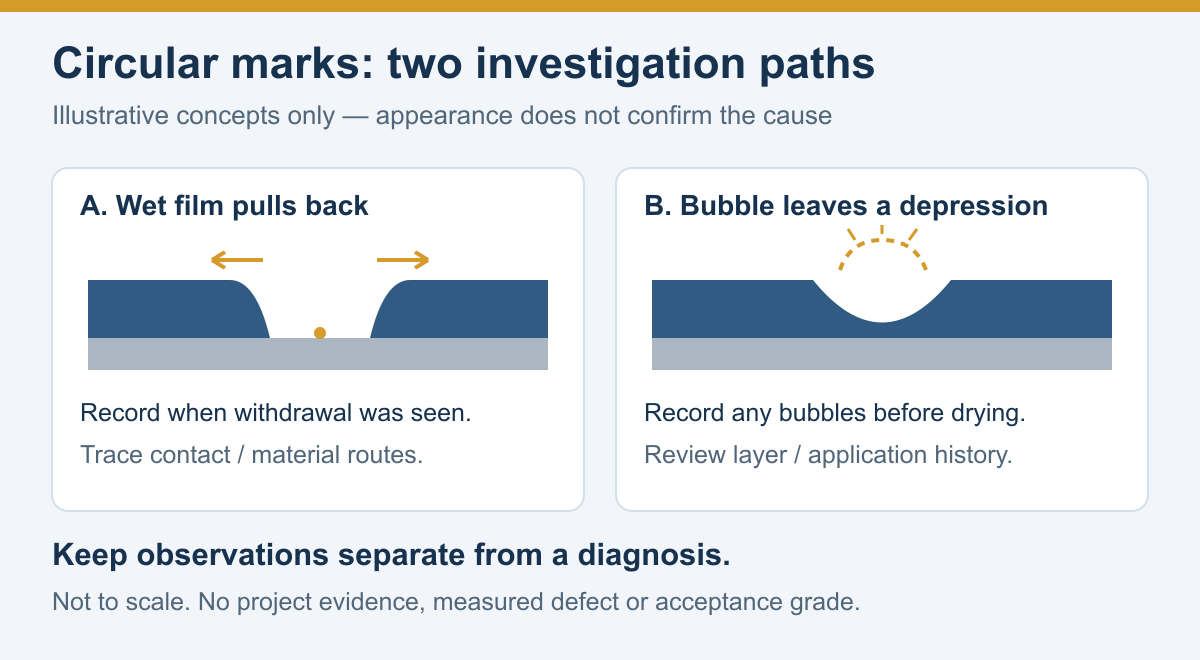
When circular depressions appear in a marine coating, first record when they formed, whether the wet film visibly pulled back, and which layer is visible at the center. Then review possible contamination routes and the application history before choosing a repair. A crater-shaped mark alone cannot identify silicone, establish defect depth or demonstrate that the surrounding coating is acceptable.
This guide helps shipyards, coating contractors and inspectors organize that investigation on marine steel. It is a troubleshooting record framework, not a product-specific repair specification. The coating manufacturer's instructions and the project's inspection and repair requirements govern the work.
Clarify the terms before diagnosing the mark
Manufacturers do not always use the same defect names. Interlux's marine cratering and dimpling guide distinguishes coating withdrawal associated with cissing/dimpling from depressions left by bursting air or solvent bubbles during drying. Its cissing description includes a visible underlying surface; its dimpling description does not.
PPG's automotive refinish fisheyes guide uses “dimples or craters” for defects appearing in wet paint after spraying. This terminology comparison does not make an automotive correction method suitable for a marine coating.
For an inspection report, pair the working label with a description. “Circular depression observed while still wet; lower layer visible” communicates more than “fisheyes everywhere.” If nobody observed formation, record the time the marks were discovered and leave the mechanism unconfirmed.
| Observation | Question to resolve | Record or referral |
|---|---|---|
| Wet film appears to retreat from isolated spots | Was withdrawal actually observed, or inferred from a dry mark? | Time-stamped observations and close/wider photographs of the same location |
| Bubbles were observed before depressions appeared | Which layer and application stage were involved? | Sequence of observations, coating identity and application log |
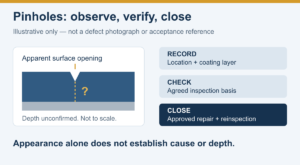
| A small apparent opening remains after drying | Is it a depression, an opening, or an unresolved surface feature? | Refer to the pinhole inspection guide for that separate inspection task |
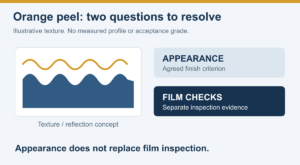
| Broad pebbled texture rather than isolated recesses | Is general texture the main concern, with separate local marks? | Use the orange peel investigation and log any depressions separately |
The table is an editorial observation aid, not an acceptance standard. Do not assign a universal diameter or permissible count from a generic defect description.
Trace the route, not just the suspected contaminant
Possible contamination sources in PPG's refinish guidance include the prepared surface, air lines or hoses, and materials or hands contacting the work. Silicone is one possibility, not a diagnosis established by the shape. Use those categories to ask where contact occurred; do not import the page's cleaners, extra-coat advice or additives into JD instructions.
Create a route record linking a particular area to the equipment and materials actually used there. The following prompts are an investigation structure, not proof that any listed item caused the defect.
| Route to investigate | Evidence to collect | Useful comparison |
|---|---|---|
| Prepared surface and underlying coat | Area identification, preparation/cleaning record, previous coating and time before application | Adjacent areas with a documented difference in preparation or exposure |
| Air supply and application equipment | Compressor/line/hoses used, service history, equipment changes and relevant inspection records | Affected and unaffected areas served by identified equipment |
| Contact materials and handling | Cloth, glove, masking and tool identities where traceable; work sequence | Whether the pattern follows a contact boundary rather than an entire batch |
| Paint components and additions | Exact product, component/batch labels, mixing record and any added material | Areas from the same mix compared with separately documented mixes |
| Work environment and neighboring activity | Location, timing, access and relevant work nearby | Whether onset corresponds to a recorded change, without assuming causation |
Where air quality needs investigation, use the separate compressed-air blotter test checklist to agree the check's scope and record. A result from another hose or earlier period should not be presented as direct evidence for this application without establishing the connection.
Keep the affected-area map and equipment/mix references together. A photograph that cannot be traced to a layer, location and application period has limited value when several teams worked on the vessel.
Review bubble formation as a separate hypothesis
If bubbles were seen before the marks appeared, preserve that observation rather than automatically reclassifying every recess as a contamination fisheye. Interlux identifies released air or solvent as a possible crater mechanism and also notes unsuitable thinner/retarder use in its cissing/dimpling discussion. Neither statement establishes what happened on a particular JD coating.
For the technical review, assemble the actual substrate and previous-layer identity, mixing/application times, added-material identity, method, film records and environmental log. State temperature in °C or °F and film thickness in µm or mils, with wet and dry readings clearly distinguished. Record missing values as missing; do not reconstruct them from a photograph.
Do not change induction time, thinner, dilution or application settings simply to test a generic internet explanation. Resolve the exact product requirements first. If the underlying layer may be porous, refer to the pinhole article rather than treating porosity as a universal explanation for all circular marks.
Plan a controlled comparison before expanding the repair
An agreed comparison area can help evaluate a proposed corrective action. Ask the responsible technical parties to define its size/location, materials, preparation, application conditions, observation times and acceptance basis. It should be traceable and representative of the question being investigated.
Document the baseline and the proposed change before work. Where feasible, avoid changing several suspected factors together: an improved appearance would then provide little evidence about which change mattered. If several changes are necessary, record that limitation instead of claiming a confirmed root cause.
| Review point | Decision to document | Closure evidence |
|---|---|---|
| Existing condition | Areas to retain, examine further or repair, and who authorizes the disposition | Mapped photographs and inspection findings |
| Repair instructions | Required preparation, replacement layers and applicable product documents | Approved instruction with product/layer identities and responsibilities |
| Comparison work | What differs from the baseline and what remains controlled | Trial record, observations and stated limitations |
| Final release | Required appearance, film and other project checks after the specified cure condition | Reinspection results and recorded release decision |
Do not equate “looks smoother” with completed acceptance. The project may require checks beyond appearance; those must be specified for the actual system and service. This article does not prescribe destructive examination, detector settings or a universal repair depth.
Confirm the exact JD coating documents
For a primer-layer concern, identify the actual coating through the JD marine epoxy primer range and its product code. The publicly linked JDH815 basic product sheet contains application information, but it does not provide a complete crater-investigation and repair procedure.
Obtain the current controlled technical data sheet, relevant safety data sheets for the components and any approved additions, and the project's coating/repair specification. No JD-specific cleaner, additive, dilution, repair thickness or cure interval is assigned here. The general primer application guide provides broader application context; the actual product and project documents remain necessary.
Frequently asked questions
Does a fisheye prove silicone contamination?
No. Silicone is one possible route described in automotive refinish guidance. Appearance alone does not establish chemical identity. Record the timing and trace the possible routes before making that conclusion.
Are craters, cissing and pinholes interchangeable?
No. Source terminology varies, and a visible depression does not prove an opening through the coating. Describe what was observed and use the appropriate inspection basis to resolve the remaining question.
Can I add a fisheye eliminator or spray another coat?
Only use a correction specifically authorized for the exact coating system and project. An automotive suggestion is not JD approval. Refer the proposed change for technical review before applying it to the vessel.
Request a cratering investigation review
If circular depressions appeared during a shipyard coating job, send JD Marine Paint a technical inquiry with the product/component labels, affected layer and area map, service exposure, timing of first observation, photographs, and available application/inspection records. Include the current controlled TDS/SDS and the proposed repair question. This gives the review a defined location, coating system and evidence trail instead of relying on a defect name alone.