What can a solvent rub test tell a marine coating buyer?
A solvent rub test evaluates a coating's resistance to a specified solvent under a defined procedure. For marine work, identify the coating, select an applicable method and agree the result required before testing. The report must connect the observed response to those conditions; a statement such as “MEK passed” is insufficient on its own.
Use this guide to review an inspection request or contractor report. It provides a document checklist and reporting structure, not a substitute for the controlled test procedure. No JD solvent choice, rubbing count or acceptance value is assigned here.
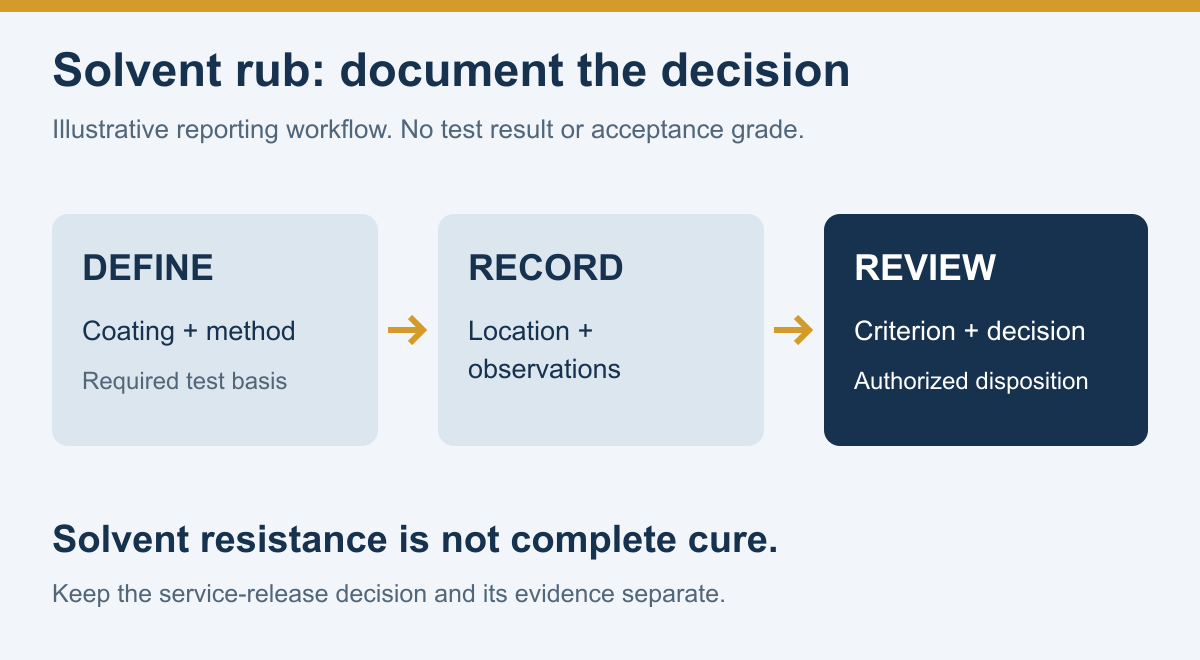
Original reporting concept, not a test demonstration or project record. The diagram shows information flow only; it depicts no passed specimen or acceptance scale.
Select the method for the coating actually applied
The public catalog for ASTM D5402-19(2024) covers chemically curing organic coatings. It leaves selection of the solvent, required double-rub count and expected response to the applicable requirements rather than supplying a universal combination. Confirm these details with the manufacturer and project documents.
The catalog for ASTM D4752-20(2024) addresses MEK resistance of ethyl-silicate inorganic zinc-rich primers. Its required rating before a particular topcoat must be agreed in advance. A product described merely as “zinc-rich” has not yet been identified sufficiently to select that practice.
| Coating identification | Method-selection question | Resolve before issuing the test request |
|---|---|---|
| Chemically curing organic coating | Is D5402 the specified, applicable practice? | Exact product, controlled procedure revision and manufacturer requirements |
| Ethyl-silicate inorganic zinc-rich primer | Is D4752 the applicable specified practice? | Binder identity, intended topcoat and required rating |
| Unidentified coating or mixed records | Can the product and coating stage be established? | Product/batch evidence and technical direction before choosing a method |
This is an editorial selection checklist, not an equivalence table. Do not substitute one method's result description or criterion into another method's report. Keep the exact designation and revision in the inspection request so the applicator, inspector and reviewer are discussing the same procedure.
Define the test request before the inspector starts
Build a short request that a second inspector could understand without an oral explanation. Identify the vessel or structure, area, coating layer and reason for the check. State whether the result supports a proposed next coat, a specified inspection stage or another defined decision. Naming the intended decision helps expose a missing criterion before work begins.
Use the original request matrix below alongside the applicable procedure. It does not reproduce a standard's operating instructions.
| Request field | Information to supply | Review question |
|---|---|---|
| Coating and location | Product, batch, layer, application record and marked test position | Can the specimen be traced to the identified area? |
| Method basis | Selected procedure and revision, plus applicable manufacturer instruction | Is the method suitable for this coating and stage? |
| Solvent and endpoint | Required solvent identity, counting convention, endpoint and result criterion | Is the source of each requirement clear? |
| Conditions | Required conditioning basis and available application/drying history | Are stated conditions supported by the area record? |
| Authorization and closure | Permission to test, responsible reviewer and any required repair | Who can release the location after testing? |
If the requirement is expressed in double rubs, use the counting definition in the selected procedure. Do not convert an unlabeled number of hand movements into a reported result after the event. Likewise, record the exact solvent identity from the approved instruction rather than replacing it with a familiar shop solvent.
Preserve the observations and their location
Make the report distinguish instructions from observations. The required endpoint belongs in the method section; the response actually observed belongs in the results section. Keep the original test record and any photographs together, with location and time identifiers. An image of a cloth without its coating, solvent and procedure context is difficult to review.
Retain the completed count or endpoint as required by the method, the recorded coating response, the operator and the inspection time. Explain interruptions or departures rather than silently treating them as standard execution. Where the method requires comparison areas or particular observations, identify those records explicitly.
Label physical quantities: temperature in °C or °F, film thickness in µm or mils, and elapsed time in a clearly stated unit. Keep air and surface readings distinct. The dry-film thickness inspection guide addresses the separate thickness record; a rub result is not a thickness measurement.
The prompts below illustrate report-review gaps. They describe no actual test or JD acceptance decision.
| Report entry or gap | Clarification to request | Keep the decision open until |
|---|---|---|
| “Passed” without the test basis | Identify solvent, method, endpoint and agreed criterion | The stated conclusion can be checked against the requirement |
| A count without a counting convention | Confirm the procedure and how the count was recorded | The original result is understandable without a guessed conversion |
| Different observations at separate locations | Retain each location's result and investigate the difference | The required coverage and individual dispositions are resolved |
| Missing or uncertain execution details | Record what is known and obtain a technical disposition | Any further authorized action is defined and documented |
Keep solvent resistance separate from full cure and service release
ASTM's public D5402 explanation cautions that solvent resistance alone does not establish complete cure or suitability for service. That distinction matters when a favorable rub report arrives before a tank lining or exterior system is due to enter its intended exposure.
Hempel's testing-after-painting guidance also emphasizes careful interpretation, local test coverage and repair of test-related damage where required. Use that manufacturer context without transferring its product-specific ratings or procedural examples into a JD inspection plan.
Keep the product's application and curing history available. The pot-life and induction-time guide covers mixed-material planning, while the recoat-window article covers the next-layer timing decision. Neither clock should be silently replaced by a rub-test conclusion.
An adhesion result answers another inspection question. See the existing marine coating adhesion guide when reviewing attachment or failure location, and keep its evidence separate from the solvent-response report.
Resolve safety, product documents and test-area closure
Testing requires an approved solvent and a suitable work arrangement. Review the relevant supplier SDS and site controls before use; do not select a solvent, protective equipment or exposure limit from this article. If the necessary instructions or authorization are missing, obtain them before the test proceeds. Record how any affected test location will be assessed and repaired under the applicable system instructions.
For the JD marine epoxy primer range, obtain the exact product's current TDS, component SDS and approved inspection requirements. The available JDH815 public sheet does not define a complete solvent-rub acceptance procedure. Its thinner entry is not permission to use that thinner as a test solvent.
Request written clarification of method applicability and the criterion for the intended decision. Keep the original report, technical response and any retest or repair references linked so a later reviewer can follow the closure without rewriting the first observation.
Frequently asked questions
Does every marine epoxy require an MEK rub test?
Confirm the inspection requirement for the exact coating and project. MEK should not become the automatic test solvent simply because it is associated with a different method or product.
Can a supplier's “pass” statement release the whole vessel area?
Review the agreed sampling coverage, location records and decision authority. A report needs enough context to support its stated scope; resolve untested or uncertain locations through the inspection plan.
Can a favorable rub result replace an adhesion test?
Keep these as separate checks where the project requires them. Do not rename a solvent-response result as evidence of attachment strength or use it to fill an unperformed inspection item.
Request a solvent-test document review
Preparing a dry-dock hold-point release or reviewing a contractor's solvent-rub report? Contact JD Marine Paint with the product/layer, service exposure, selected procedure, proposed solvent and criterion, mapped results and application history. Identify the next planned operation and any missing approval so the review can address the actual decision the report is meant to support.