What does paint density mean for a marine coating buyer?
Paint density is the mass of liquid coating divided by its volume at a stated temperature. A useful report identifies the product and sample state, the measurement method, the cup volume, the net sample mass and the temperature. A number without that context is difficult to compare with a supplier's specification.
For a shipyard receiving a batch or a distributor reviewing a discrepancy, start by checking whether both records describe the same material: an individual component, a mixed coating or a thinned application mixture. These are different reporting bases. This guide explains the calculation and a practical document review; it assigns no universal density range or JD acceptance tolerance.
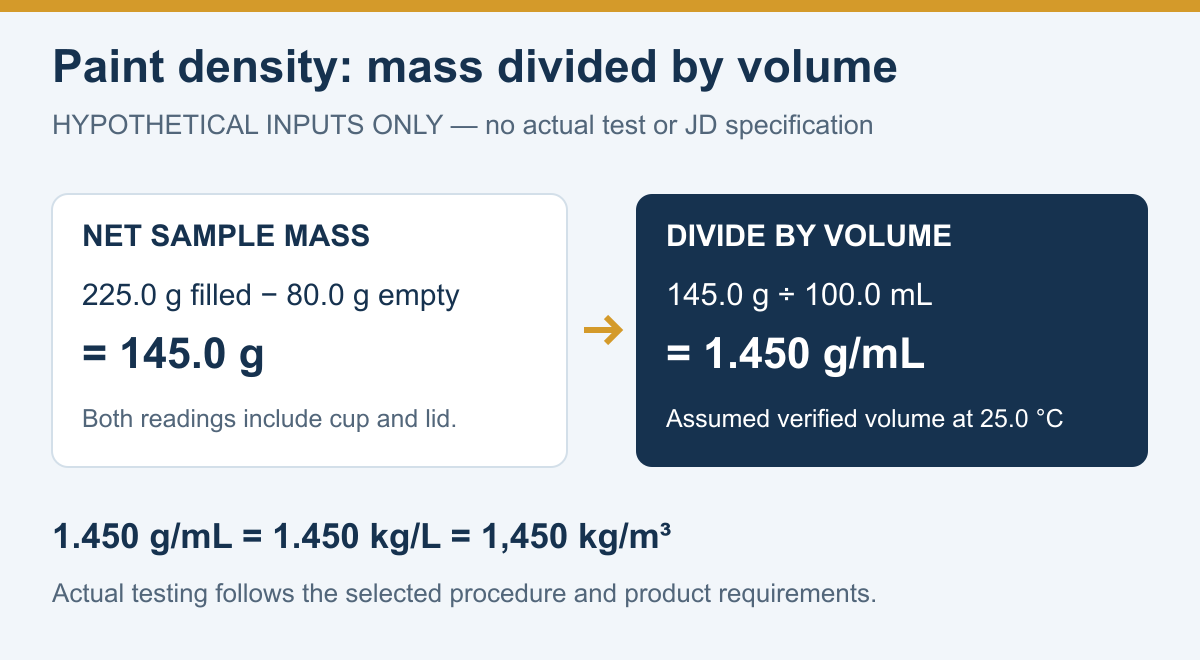
Original educational diagram with hypothetical inputs. It is not a photograph, test record, calibrated instrument drawing or JD product specification.
Keep density, specific gravity and other properties distinct
Use a mass-per-volume unit with density. For example, 1 g/mL = 1 g/cm³ = 1 kg/L = 1,000 kg/m³. Converting between these units changes the number or notation, not the material being described. If a report uses pounds per gallon, establish which gallon definition applies before comparing it with another report.
Specific gravity is a density ratio with no mass-per-volume unit. Elcometer's density-cup guidance describes comparison with water at the same temperature. Retain the reference basis; do not simply relabel a density value as specific gravity.
| Property | What the record describes | What it does not establish by itself |
|---|---|---|
| Liquid paint density | Mass per volume of the identified sample at the recorded temperature | Component mixing ratio or dry-film performance |
| Specific gravity | Density relative to the stated water reference | A density unit such as kg/L |
| Viscosity | Resistance to flow under the stated measurement conditions | Mass contained in a litre of paint |
| Volume solids | The relevant nonvolatile-volume proportion, on its declared basis | Liquid density or a measured film thickness |
This is an editorial comparison, not a conversion chart. Use the separate paint-viscosity guide for flow-cup and viscosity records. The marine paint consumption article explains the coverage calculation; a density check does not replace its required inputs.
Choose a suitable density method and record the sample basis
The current public catalog for ASTM D1475-13(2025) identifies a method for liquid coatings, inks and related components. Another reference, ISO 2811-1:2023, describes metal or Gay-Lussac pycnometers for low- or medium-viscosity materials at the test temperature. A familiar cup is not enough to establish that a selected method suits every sample.
Name the required method and revision in the test request. Obtain the controlled procedure and instrument instructions for actual execution, including conditioning, sample preparation, volume verification and reporting requirements. This article is not a full ASTM or ISO procedure and does not declare the two methods interchangeable.
Before taking a sample, resolve the product identity, batch, component or mixture state and any declared thinner addition. For a reactive mixture, retain the relevant preparation and timing record. Compare like with like rather than comparing a component result with a mixed-product value.
Elcometer's cup description uses the difference between filled and empty cup-and-lid masses, divided by the cup's known volume. Its guidance also calls attention to complete filling, unwanted air pockets and removal of excess material before weighing. Apply those controls through the chosen procedure, not through improvised adjustments to make a result match a target.
Check the mass-and-volume calculation
For a cup-and-lid measurement, keep both original balance readings:
Net sample mass = filled cup-and-lid mass − empty cup-and-lid mass
Density = net sample mass ÷ applicable cup volume
The following is a hypothetical arithmetic example, not a measurement, recommended instrument precision or product acceptance limit. Assume the sample and cup are at 25.0 °C, and that the applicable verified cup volume at that condition is 100.0 mL. That temperature is an example input, not a universal test requirement.
| Hypothetical input or result | Value | Role in the calculation |
|---|---|---|
| Empty cup and lid | 80.0 g | Tare assembly mass |
| Filled cup and lid | 225.0 g | Gross assembly mass |
| Net sample mass | 145.0 g | 225.0 − 80.0 |
| Applicable cup volume | 100.0 mL | Assumed verified volume at the example condition |
| Calculated liquid density | 1.450 g/mL | 145.0 ÷ 100.0 |
The same calculated density is 1.450 kg/L, or 1.450 × 10³ kg/m³. Dividing the gross mass by the volume would incorrectly include the cup and lid. Using a guessed capacity would introduce a different error. Keep the calculation attached to the original readings so a reviewer can check both choices.
No specific gravity is calculated here because a water-density reference has not been supplied. For an actual report, use the selected method's required units, precision and rounding; extra displayed digits cannot establish measurement accuracy.
Use a traceable density QC record
The blank template below is an original record aid. Empty entry cells are intended for the operator's data; they do not represent missing results from a performed test. Add any further fields required by the selected procedure.
| Record field | Entry | Review prompt |
|---|---|---|
| Product, batch and sample ID | Can the retained sample and source container be traced? | |
| Component or mixture state | Are mixing, thinning and relevant times identified? | |
| Method and revision | Is the required procedure applicable and available? | |
| Cup/lid ID and volume basis | Is the volume traceable to this assembly and condition? | |
| Balance ID and verification record | Is the weighing record linked to the equipment used? | |
| Test temperature and conditioning | Are units and actual conditions recorded? | |
| Empty and filled assembly masses | Are both original readings retained with units? | |
| Result and reporting unit | Can the net-mass calculation be reproduced? | |
| Criterion, reviewer and disposition | Who supplied the limit and authorized the decision? |
Where repeats are required, preserve the individual readings and apply the selected method's reporting rule. Do not erase a discrepant result by recording only a preferred reading. Keep corrected calculations identifiable and retain the original record.
Investigate a mismatch before changing the coating
A density outside the applicable specification warrants review, not an automatic thinner addition. ASTM's public catalog identifies density as a quality-control property, but that does not make a single difference a diagnosis of its cause.
First confirm the comparison basis: product variant, batch, sample state, units, temperature, method and agreed tolerance. Then review the original masses, applicable cup volume, equipment records and any noted filling or sample-preparation problem. Ask for a documented repeat or supplier review when the evidence is incomplete. Preserve the first result and the reason for further action.
When checking a JD primer shipment, confirm the product identity through the epoxy primer range and request its controlled TDS together with the relevant component/thinner SDS. The linked JDH815 public sheet labels its density as an after-mixing value. That wording does not supply an individual component density or a complete batch-acceptance procedure. Confirm the applicable temperature, test basis and tolerance with JD before judging a shipment.
Follow the SDS and site controls for sampling, cleaning and waste handling. This document does not select a cleaning solvent or prescribe chemical-handling equipment.
Frequently asked questions
Can mixed-paint density determine the component ratio?
A mixed density alone does not identify the required quantities of both components. Use the manufacturer-approved ratio and basis. The existing weight-versus-volume mixing guide covers that separate task.
Does a higher density mean better corrosion protection?
Density alone cannot establish that conclusion. Review the specified coating system and its relevant performance evidence rather than ranking different products by a single liquid property.
Can two density results be compared at different temperatures?
Check the applicable method and supplier basis first. Record both temperatures and obtain an approved comparison or correction approach; do not invent a universal correction factor.
Request a review of a density discrepancy
Reviewing an incoming marine-coating batch or a contractor's density report? Send JD Marine Paint the product and batch details, component/mixture state, method, temperature, cup-volume basis, original masses and the specification being used. Include the intended coating layer, substrate and service exposure, plus the decision being held, so the technical review can address the actual discrepancy.