The recoat window is the permitted interval for applying the next specified coating layer under stated conditions. For marine epoxy work, confirm the previous product, next product, service environment and temperature basis, then apply the documented minimum and maximum intervals. Check surface condition and any additional preparation requirements before release. Elapsed time alone does not authorize another coat.
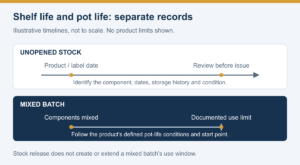
A useful dry-dock schedule connects the timing requirement to an identifiable hull zone or compartment. It also preserves the evidence behind a release decision when shifts change or work is delayed. This guide focuses on that layer-to-layer handover; the separate pot-life and induction-time guide covers mixed-batch planning.
Confirm the product pair and document revision
Start with the coating schedule and controlled product documents. “Epoxy primer followed by topcoat” is too broad: identify the exact products, layer sequence and intended exposure. Obtain clarification where a table does not cover the proposed pairing or service.
As an example of how a manufacturer structures this information, the current Hempel Epoxy Primer HV data sheet, issued October 2026, separates drying stages from an overcoating table. That table identifies subsequent products, temperature columns and exposure conditions. Its figures concern that Hempel system and are not JD Marine Paint instructions. No Hempel interval is transferred into the schedule below.
Use this editorial work-pack checklist to prevent a time value from becoming detached from its conditions.
| Item to resolve | Required identification | Scheduling consequence |
|---|---|---|
| Previous and next coats | Exact product names and coating stage | Select the applicable product-pair requirement |
| Intended service | Atmospheric or immersion exposure, as applicable | Use the requirement for the specified service |
| Document basis | TDS/application instruction and project specification revisions | Keep the source of each interval traceable |
| Temperature basis | Required temperature parameter and applicable conditions | Retain the evidence supporting the selected interval |
| Clock definition | Event that starts the interval and meaning of its deadline | Calculate against the agreed event for each area |
| Surface release | Cleanliness, coating condition and preparation requirements | Review these alongside the timing record |
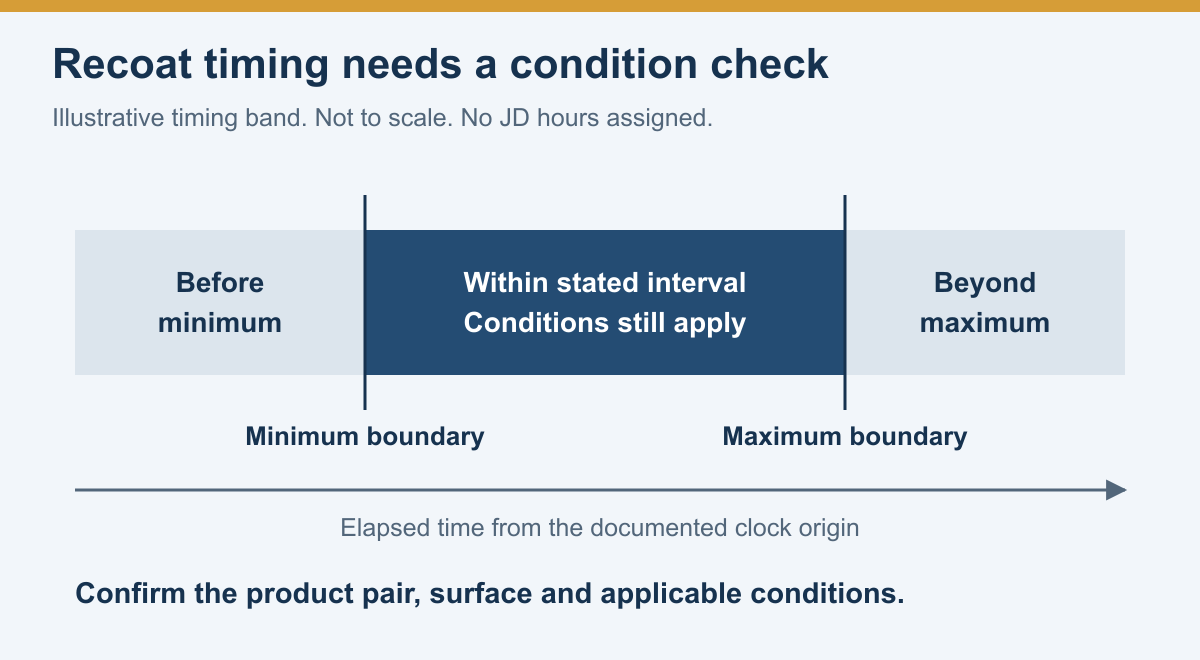
Read the minimum and maximum together
Hempel's June 2023 explanatory notes explain overcoating intervals and their dependence on application and exposure conditions. They describe possible film defects from overcoating too early and reduced intercoat adhesion when the recommended maximum is exceeded. They also require attention to contamination and any preparation needed before overcoating.
Use those notes as general manufacturer context. The actual JD products and approved project documents govern JD work. Do not infer readiness from a touch-dry observation, a mixing-pot deadline or a convenient end-of-shift time. Record the event used to start the coating-area clock.
If a document uses a term such as “extended” or “none” for a maximum, establish its product-specific meaning and conditions. Such wording should not become an undocumented assumption that a dirty or weathered surface can be overcoated indefinitely.
Use the actual condition history
Distinguish air, paint and surface temperatures in the record. Read which parameter the applicable document uses instead of replacing it with an unrelated thermometer reading. Keep unit labels, measurement times and locations attached to the area history.
Hempel's hot-climate application guidance warns that elevated-temperature overcoating intervals may be shorter and may not be supplied in the standard data table. It directs users to obtain system-specific advice. This supports asking for clarification when conditions fall outside the documented basis; it does not provide a JD temperature-to-time conversion.
For changing conditions, do not average temperatures or interpolate intervals unless the applicable instructions permit that approach. Retain the available history and ask the responsible technical authority how to interpret it. Likewise, explain relevant interruptions, exposure and film-build information rather than silently assuming the published reference conditions continued overnight.
Build a schedule for each defined area
Before calculating dates, agree whether a deadline governs starting or completing the next coating operation. The example below assumes that both limits govern the start of the next coat and that the previous coat's recorded completion starts the clock. These are illustrative assumptions, not universal rules.
Hypothetical example: assume a documented minimum of 10 hours and maximum of 36 hours for a particular approved product pair. Assume the stated conditions remain applicable throughout. The previous coat is completed at 08:00 on Day 1.
| Schedule event | Arithmetic | Illustrative time |
|---|---|---|
| Previous coat completed | Agreed clock origin | Day 1, 08:00 |
| Earliest next-coat start | 08:00 + 10 hours | Day 1, 18:00 |
| Latest next-coat start | 08:00 + 36 hours | Day 2, 20:00 |
At Day 2, 16:00, 32 hours have elapsed and 4 hours remain to the assumed maximum. That arithmetic identifies a planning constraint, not a release. The crew must still complete the required surface review, confirm applicable conditions and obtain the documented decision. Do not mix a batch merely because a calendar calculation appears favorable.
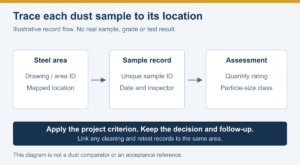
A vessel-wide “primer complete” timestamp can obscure areas coated at different times. Use the area divisions agreed in the inspection plan and carry them through the application and next-coat records. If work shifts to another zone, check that zone's own history rather than borrowing the first area's deadline.
Hold and resolve an exceeded or uncertain window
When the timing basis is missing or a limit is exceeded, stop the affected area's recoat decision and obtain an approved disposition. The following prompts organize the handover; they do not prescribe a repair method.
| Situation | Next coordination step | Evidence needed for closure |
|---|---|---|
| Minimum has not been reached | Reschedule and retain the relevant condition history | Confirmed earliest time and remaining release checks |
| Maximum has been exceeded | Obtain system-specific assessment and preparation instructions | Written disposition, preparation record and inspection release |
| Conditions are outside the table or uncertain | Clarify the applicable timing basis before using it | Technical direction linked to the recorded conditions |
| Surface condition is unsatisfactory | Resolve contamination, damage or other identified concern | Approved corrective action and required reinspection |
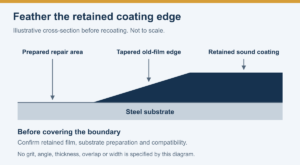
Do not assume that a quick sanding pass, solvent wipe or an additional coat automatically restores permission. Specify the required cleaning, preparation, inspection and subsequent timing through the approved instructions. Where blush is suspected, use the separate amine-blush identification and removal guide to frame the contamination question; this article does not repeat that cleaning procedure.
Keep a traceable recoat handover
An area-based register can retain these fields together:
- Area/drawing ID and previous/next product identifiers.
- Previous-coat application record, clock origin and time zone.
- Applicable document revision, minimum/maximum intervals and their conditions.
- Temperature/exposure history and inspection references.
- Calculated scheduling bounds, surface-review outcome and responsible release authority.
- Any hold, technical disposition, corrective action and actual next-coat application time.
This is an editorial record structure. Populate it from actual work and the selected procedure. Keep amendments visible so a later reviewer can distinguish the original calculation from a revised technical instruction.
Confirm the JD system requirements
Product downloads for the JD marine epoxy primer range include the public JDH815 document. Its recoating entry does not establish a complete temperature-by-subsequent-product minimum/maximum matrix for every proposed service. It cannot define a universal window for the primer range.
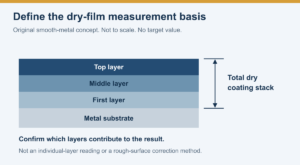
Request the controlled latest TDS, component SDS, application instructions and approved system schedule for the job. The 10-hour and 36-hour figures above are hypothetical only. No JD interval, temperature adjustment factor or missed-window repair permission is assigned here.
Frequently asked questions
Does touch dry mean ready to recoat?
Use the documented overcoating requirements. A named drying stage should not be substituted for the product-pair timing and surface-release checks.
Does reaching the recoat window mean ready for immersion?
No. Applying the next layer and releasing the completed system to service are separate decisions. Confirm the specified cure and service-release conditions.
Can I use the same window for every epoxy topcoat?
Verify the exact previous/next products, service and conditions. Resolve an unlisted pairing before applying a time from another system.
Request a layer-to-layer scheduling review
Coordinating a delayed dry-dock shift or an epoxy-to-topcoat handover? Contact JD Marine Paint with the product pair, service area, application timestamps, temperature history, achieved film-build records and current surface condition. Include the governing documents and proposed next-coat time so the review can address the actual scheduling question.