For an unthinned liquid coating, calculate the theoretical wet film thickness (WFT) by dividing the specified dry film thickness (DFT) by the coating’s volume-solids fraction. Check the wet film during application, account for any approved thinning, and verify the cured film separately. A calculated WFT is an application target, not proof that the finished marine coating meets its specification.
For a shipyard team, the useful output is a short instruction tied to a particular product, coat and work area. The calculation should tell the applicator what to check, while the inspection record preserves how that target was established.
What do WFT, DFT and volume solids mean?
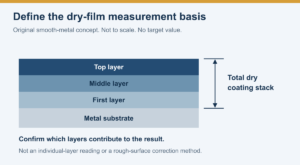
Wet film thickness describes the coating before drying or cure; dry film thickness describes the film afterward. Volume solids expresses the proportion of liquid coating volume expected to remain as film. Elcometer’s wet-film introduction explains the volatile and non-volatile components behind this relationship.
Use solids by volume, not solids by weight. For a two-component coating, confirm that the value applies to the correctly mixed material. Keep thickness units consistent: use micrometers (碌m) throughout the calculation, or use mils throughout. A mil is one-thousandth of an inch, not a millimeter.
Before issuing a target, identify these inputs:
| Input | Where to confirm it | Question to resolve |
|---|---|---|
| DFT for this coat | Approved coating specification and current TDS | Is this a per-coat requirement or the whole system total? |
| Solids by volume | Product TDS | Does it apply to the selected product, mixed components and shade? |
| Thinner addition | Approved application instructions and batch record | What was added, how much, and on what percentage basis? |
| Measurement method | Inspection plan and instrument instructions | Can the gauge resolve the target on this geometry? |
Do not divide the total system thickness by an assumed number of coats. A primer, intermediate layer and finish may have different requirements.
How to calculate wet film thickness from dry film thickness
For material applied without added thinner:
WFT = target DFT 梅 volume-solids fraction
If the TDS gives a percentage, divide it by 100 first. Equivalently, WFT = target DFT 脳 100 梅 volume solids (%). The reverse prediction is DFT = WFT 脳 volume-solids fraction. These are the relationships described in Elcometer’s calculation guide.
Worked example: a hypothetical coating
Assume a single coat requires 90 碌m DFT, the mixed coating has 60% solids by volume, and no thinner is added. These are teaching assumptions, not a JD Marine Paint product specification.
- Convert 60% to 0.60.
- Calculate 90 碌m 梅 0.60 = 150 碌m WFT.
- Reverse-check: 150 碌m 脳 0.60 = 90 碌m predicted DFT.
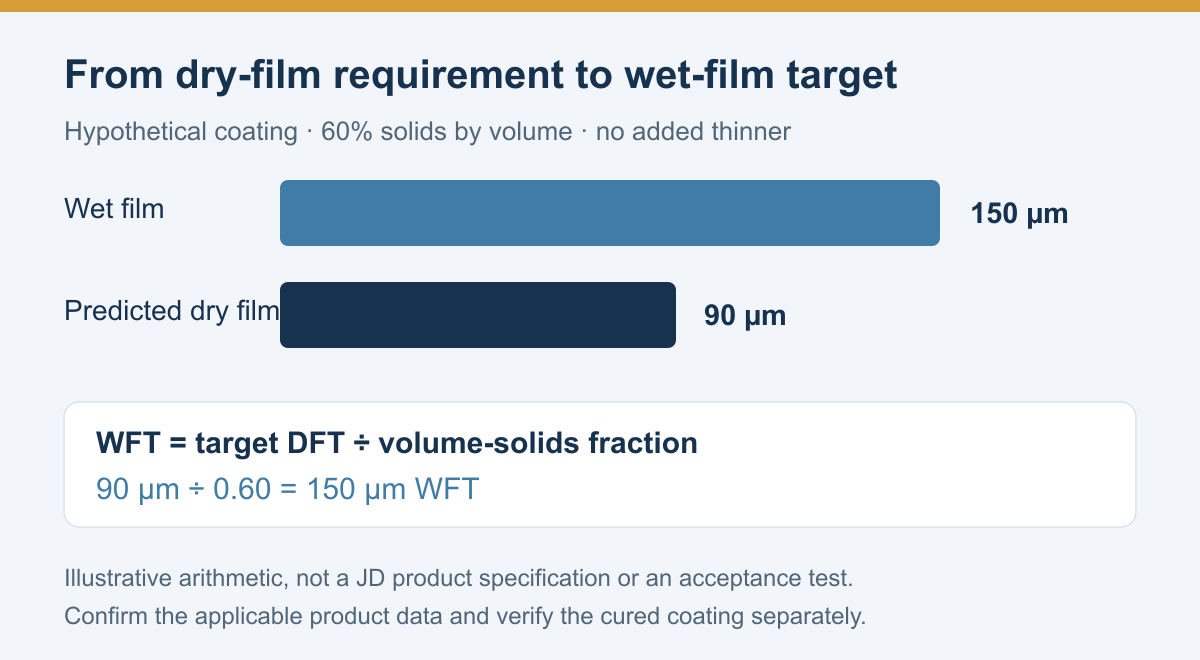
Illustrative arithmetic only. Product instructions and project requirements determine the actual application target.
Before handing over the result, write down its assumptions. 鈥�150 碌m wet鈥� without the product, coat and dilution basis leaves the next shift unable to check whether the instruction still applies.
What changes when approved thinner is added?
Solids-free thinner adds liquid volume without adding film-forming solids. Dulux Protective Coatings Technical Note 5.3.1, page 2 describes the resulting adjustment.
When thinner volume is expressed relative to the mixed, unthinned coating volume:
Adjusted solids fraction = original solids fraction 梅 (1 + t)
WFT = target DFT 脳 (1 + t) 梅 original solids fraction
Here, t is that thinner fraction. Continue the hypothetical example, assuming the manufacturer permits a 10% by-volume addition: 1 L thinner added to 10 L mixed coating gives t = 0.10. The predicted WFT becomes 90 脳 1.10 梅 0.60 = 165 碌m. Adjusted solids are approximately 54.5%.
This calculation does not authorize thinning. It assumes additive liquid volumes and a thinner that contributes no solids. A percentage based on final diluted volume, a weight-based addition or a reactive additive requires a different assessment. Record the actual addition and obtain product-specific direction if its basis is unclear.
How to read a wet film comb
Use a clean, undamaged comb with a suitable range and graduations. Measure promptly after application, before the coating starts to set. Following the instrument instructions, place the comb perpendicular to the surface so its reference teeth contact the substrate or sound previous coat; lift it without dragging. Identify the highest marked value wetted and the next higher value remaining dry. The wet film lies between them. Elcometer’s measurement guide explains this interpretation.
For example, if 150 碌m is wetted and the adjacent 175 碌m tooth is dry, record the 150鈥�175 碌m bracket, with the instrument and location. Follow any specified reporting convention; do not invent a precise midpoint measurement.
Repeat at the locations required by the inspection plan. Clean the comb between checks using the approved method, and deal with any measurement marks according to the application procedure.
When should a reading trigger a review?
Treat a suspicious reading as a question to resolve before application continues over a larger area. The following prompts organize the discussion; they are not universal repair instructions.
| Observation | Check first | Record the next decision |
|---|---|---|
| Readings repeatedly below the working target | Correct product, arithmetic, dilution record and application settings | Adjustment agreed, area affected and recheck location |
| Readings repeatedly above target | Correct coat requirement, gauge scale and overlap pattern | Review against permitted film build before deciding what to do |
| No clear wet/dry boundary on the comb | Gauge condition, timing and suitability for the surface | Repeat with a suitable method; retain the inconclusive result |
| Wide differences across an area | Whether readings refer to the same coat, batch and geometry | Map locations separately instead of hiding variation in one average |
For preparation, mixing and broader application questions, use the marine primer application and troubleshooting guide.
Why WFT cannot replace final DFT inspection
The calculation predicts film build under stated assumptions. Surface profile, geometry, application variation and drying behavior can affect the relationship in practice. DeFelsko’s wet-film measurement guidance distinguishes application checks from verification of the cured coating.
Use the project’s specified DFT inspection method and acceptance criteria once the coating is ready for measurement. Do not turn a comb bracket into a final DFT result, and do not apply one universal minimum, maximum or sampling frequency to every vessel area.
For JD products, start with the marine epoxy primer documents or the marine epoxy paint range. The publicly linked JDH815 data sheet includes volume solids and wet/dry film figures. Obtain the current controlled TDS and SDS for the actual material before work; a website example does not establish every project’s coat thickness or permitted dilution.
What should the inspection record contain?
Keep a separate entry for each inspected area and coat. A practical record should capture:
- Vessel or structure, area reference, coat number and inspection date/time.
- Product, shade, component batches and applicable document revisions.
- Specified DFT, solids-by-volume value, units and calculation.
- Thinner identity, quantity, percentage basis and authorization, or confirmation that none was added.
- Gauge identification, scale, individual wet/dry brackets and locations.
- Relevant environmental readings required by the inspection plan.
- Agreed adjustment, recheck result and responsible reviewer.
- Subsequent DFT report reference and any unresolved action.
Keep calculated targets, observed readings and acceptance decisions in distinct fields. A blank acceptance field should remain open until the required evidence exists.
Frequently asked questions
Can I use the same WFT for every layer?
Calculate each layer from its own specified DFT and applicable product data. Recheck the instruction when the product, shade, coat requirement or authorized thinner addition changes.
Should I round a target to the next comb graduation?
Record the calculated value and the actual gauge bracket. Agree on a practical working target within the product and project limits; rounding alone is not a compliance decision.
Does a good WFT reading release the area for recoating?
It supplies one application record. The release decision also needs the required film condition, preparation, timing and inspection evidence. The amine blush and recoating guide covers a separate surface-condition question.
Need a product-specific wet-film target?
Send JD Marine Paint the product code and current TDS, vessel area, per-coat DFT requirement, application method, gauge scale and proposed thinner addition. Request a technical review so the calculation can be checked against the intended coating system and project documents.