How long can marine paint remain in stock?
Use the shelf life stated for the exact product or component, together with its dating basis and required storage conditions. Check the container label and current supplier documents before issue. An unopened can, an acceptable-looking sample or a recent delivery date does not by itself establish that a batch is suitable for the planned work.
For distributors, shipyard stores and fleet maintenance teams, the useful task is to connect each container to a documented release decision. Record the identity, dates, storage history and condition. Hold stock for review when that evidence is missing or conflicts. This article provides a stock-control framework, not a universal paint expiration period.
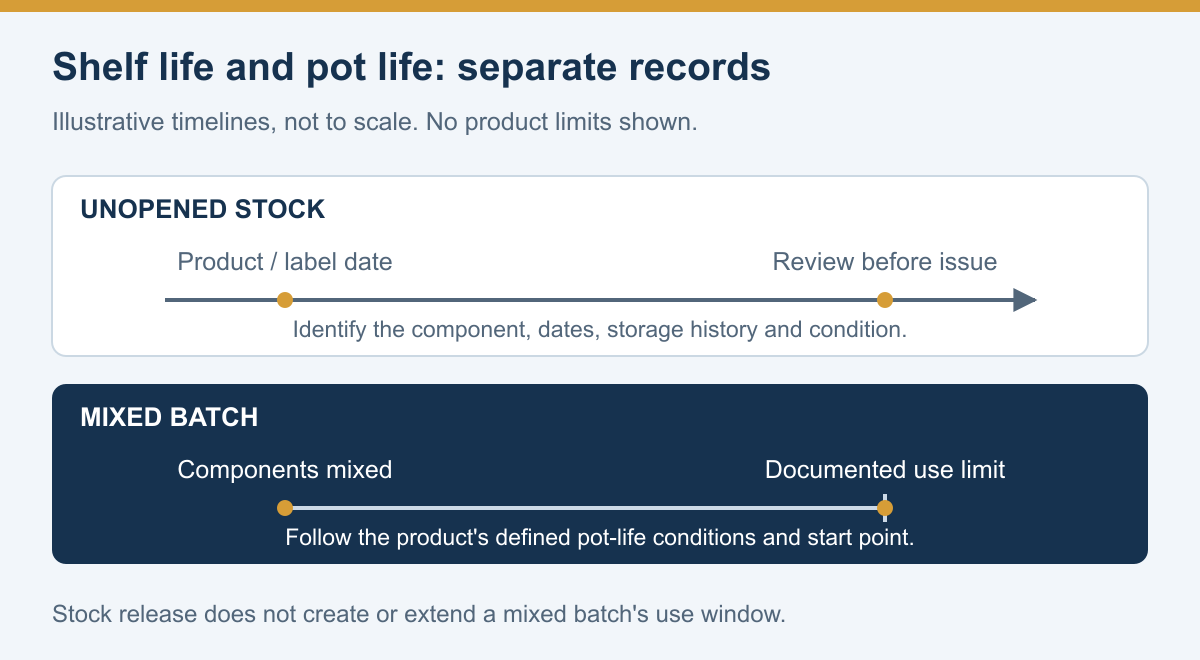
Separate shelf life from other coating time limits
Keep the container record and the application record connected, with each limit identified by name.
| Term | What the record concerns | Question before use |
|---|---|---|
| Unopened shelf life | The identified product/component in its specified original sealed packaging and storage conditions | Which label date and supplier requirement govern this container? |
| Opened-container condition | Material whose packaging has been opened, with its handling and exposure history | What written guidance covers the remaining material? |
| Mixed pot life | A batch after components are combined, under the stated product conditions | What is the batch's documented use limit and start point? |
| Coating service life | Performance of the applied system in its actual exposure | What system, maintenance and exposure conditions apply? |
Hempel's Storage of Paint guideline, issued December 2025, describes shelf life in relation to original sealed containers and recommended storage. It identifies temperature and container condition as important storage factors. That guide concerns Hempel products. Its years, temperatures and aging rules do not establish limits for JD coatings.
For the separate application clock, see our epoxy pot-life and induction-time guide. For installed performance, the marine coating service-life guide addresses a different buyer question. Neither replaces the release evidence for unopened stock.
Read the date before calculating remaining stock life
Photograph the original label and transcribe its product code, component, lot and date fields exactly. Establish whether a date means manufacture, best-before, expiry or retest. Ask the supplier to decode an unfamiliar batch code. Keep an ambiguous date format unresolved until confirmed.
Receipt is a logistics event. Do not use the delivery date as the shelf-life start date unless the product documentation explicitly does so. If a duration is stated from production, obtain the production date and the supplier's applicable date-calculation convention. Retain the original label alongside any calculated inventory date.
For example, the current Hempadur Mastic 45880 data sheet lists base and curing agent separately, ties shelf life to production and unopened containers, and notes regional climate assumptions on labels. This illustrates why the complete date basis matters. It is not a JD specification or permission to extend another manufacturer's material.
Check both members of a multi-component kit. A valid date on the base does not document the curing agent. Link the matched component codes and their separate lots, quantities and dates. If replacement components are proposed, obtain confirmation of the permitted combination before treating the kit as available.
Build a traceable FEFO stock register
First-expiring-first-out, or FEFO, means prioritizing the earliest applicable expiry among stock already cleared for the intended work. It is an allocation rule, not a quality test. A held batch must remain excluded even when it has the earliest date.
The following blank worksheet structure is an editorial stock-control aid. It contains no completed inspection or assumed shelf-life values.
| Register field | Information to enter |
|---|---|
| Stock identity | Product/component code, shade where relevant, lot, container ID, quantity and unit such as L or kg |
| Kit relationship | Matched base/curing-agent codes, separate lot IDs, allocated quantities and pairing confirmation |
| Original dates | Production, best-before/expiry/retest fields exactly as labeled, label photo and any supplier decoding |
| Governing documents | Current product TDS/application instruction, component SDS, revision and supplier clarification reference |
| Storage evidence | Locations, receipt/transfers, temperature record with °C or °F, duration of any excursion and missing periods |
| Packaging history | Original sealed/opened status, opening date if relevant, condition photos and inspection record |
| Availability | Hold/review/released status, reason, responsible person, written disposition and applicable conditions |
| Allocation and issue | Confirmed expiry basis, planned issue/use dates, FEFO order among eligible stock, recipient and work area |
Separate stock that has no verified expiry basis from stock with a confirmed date. A blank field must not sort as “no expiry.” Keep quantities in their stated units rather than combining kilograms and litres without an approved conversion basis.
Review the allocation against the actual job schedule. If delivery, staging or a planned delay puts use beyond the documented date, resolve that before dispatch. At issue, record which containers and matched components went to which crew or vessel area. This supports traceability if a supplier later requests a batch check.
Use storage history and condition to decide what needs review
Compare warehouse and transport evidence with the requirements for the actual material. A satisfactory store reading today cannot fill a missing transport history. Record known excursions with their times and temperatures instead of applying a generic “half-life” adjustment.
Use the editorial hold/review table below within the site's authorized material-control procedure. It identifies questions to resolve; it does not authorize opening damaged containers or testing suspect material.
| Finding | Stock-control action | Evidence needed to resolve it |
|---|---|---|
| Missing label or unreadable lot/date | Identify and hold the affected container from allocation | Supplier-confirmed identity/dating linked to that container |
| Dated limit exceeded, or label and documents conflict | Keep out of routine issue and request written disposition | Batch-specific supplier decision and any required project acceptance |
| Unknown temperature history or recorded excursion | Flag the affected stock for technical review | Available duration/temperature records and supplier assessment |
| Damaged, leaking, bulging or otherwise suspect packaging | Isolate from routine issue and refer handling to the site's responsible personnel | Applicable SDS/site response and supplier instructions |
| Previously opened container | Record opening/handling history and seek applicable remaining-use guidance | Product-specific conditions and authorized disposition |
| Complete identity, dates, history and acceptable condition | Complete the documented review before release | Responsible person's release record for the intended work |
Do not turn a good appearance, successful stirring or a small application trial into an automatic extension. If the supplier requests examination or testing, obtain the procedure, sampling requirements, acceptance basis and written outcome. The inspection must answer the supplier's actual question.
Ask for a written batch disposition
Send the supplier a concise evidence pack: exact product/component codes, lots, label photographs, quantities, packaging status, storage locations and temperature history. Identify the intended application and its planned date. State whether the concern is dating, an excursion, damaged packaging or opened stock.
Ask whether use is permitted, prohibited or conditional. Any revalidation should identify the affected batch, tests if required, applicable use-by conditions and the authorizing party. Preserve the original date and review history. Do not silently replace it with a newly typed date in the register.
For a JD marine epoxy primer, request the latest controlled TDS and component SDS with the batch clarification. The reviewed public JDH815 sheet does not state a shelf-life duration or storage-temperature limit. No JD expiry period, generic extension or test-and-use authorization is assigned here.
Frequently asked questions
Can I assume all unopened epoxy components have the same shelf life?
No. Verify each product/component, label and storage basis. Keep the kit relationship visible without substituting one component's date for the other's.
Should expired stock be used first to avoid waste?
Exclude held stock from FEFO allocation. Obtain its written disposition separately, then act within the resulting conditions and the site's authorized procedure.
Does resealing an opened can restart shelf life?
Do not reset the original date. Record the opening and handling history and obtain the guidance applicable to the remaining material.
Request a stock and batch-document review
Contact JD Marine Paint with product/component codes, batch and date labels, quantity, opened/unopened status, storage-temperature history and container-condition photographs. Include the planned vessel area and use date so the inquiry can resolve a specific stock-release decision.