What does a blotter test tell a marine coating inspector?
A coating-work blotter test is a visual check for oil or water in the sampled compressed-air stream. It supports inspection of air used for abrasive blasting, air cleaning or coating application. A result belongs to the identified outlet and test conditions; it does not certify every air line or every aspect of air purity.
ASTM D4285-24 is the active practice listed by ASTM for this check. Its public scope explains the purpose and notes that other contamination may need additional analytical techniques. Obtain the complete adopted procedure before performing the test. This article provides a planning checklist and record structure, without prescribing collector material, exposure duration, distance, pressure or test frequency.
Trace the air supply to the work it serves
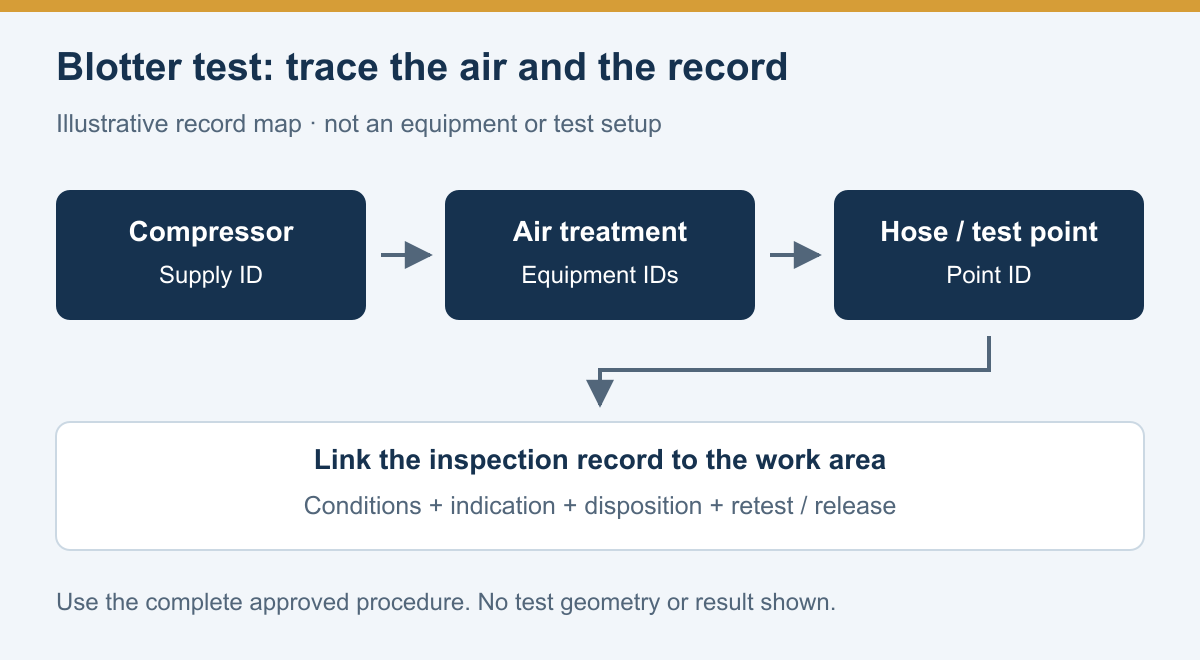
An entry saying only “compressor passed” leaves a supervisor with an important question: which air reached which operation? Prepare a simple air-line map before collecting evidence. Identify the supply, treatment equipment, distribution branch and hose or outlet relevant to the intended work.
ASTM describes examining air after it has passed through treatment such as separators, coolers or dryers. Select and document the actual test location under the approved procedure. Do not infer that a check at one location represents an unrecorded downstream arrangement.
The schematic above is a suggested way to connect equipment IDs with work-area and report IDs. It does not prescribe how to connect or operate compressed-air equipment. Keep equipment operation, isolation and testing under the site's competent personnel and approved procedures.
Agree the inspection basis before testing
Use the following as an editorial preparation checklist. It is not a replacement for ASTM D4285 or the project's inspection and test plan.
| Check before work | Information to confirm | Evidence to retain |
|---|---|---|
| Applicable requirement | Standard and adopted edition, project clause, acceptance wording and responsible inspector | Approved procedure and document revision |
| Intended air use | Blasting, surface blowdown or coating application, and the work area served | Operation and area IDs |
| Air-train identity | Supply, relevant treatment equipment, branch, hose and outlet | Marked layout or equipment list |
| Test location and conditions | Procedure-approved point and the operating conditions relevant to the check | Location ID and recorded conditions with units |
| Test materials and execution | Collector, handling, exposure and examination requirements from the complete procedure | Test record and material identification as required |
| Disposition | Who evaluates the observation, handles a nonconformance and releases work | Named responsibility and required sign-off |
Resolve conflicting instructions before the test. If the contract cites an older edition, obtain a documented decision on the adopted basis. Do not silently substitute a different procedure or import an exposure time from an unrelated online demonstration.
For the broader surface workflow, see dry-docking surface treatment. Keep the air check separately identifiable so a preparation record can point to the exact supporting report.
Record the observation without overstating the result
Enter what the inspector observed using the language and evaluation rules of the approved procedure. Keep the observation separate from the acceptance decision. An unexplained “pass” box tells a later reviewer little about the setup, requirement or work covered.
| Record group | Suggested fields |
|---|---|
| Traceability | Report ID, date/time and time zone, inspector, vessel/structure and work-area ID |
| Supply and point | Compressor/supply ID, treatment equipment, branch, hose/outlet and exact test-point ID |
| Procedure | Standard/edition, project clause, approved method revision and acceptance criterion |
| Conditions | Required operating pressure and temperature with units, instrument IDs and relevant operating configuration |
| Execution and evidence | Procedure-required test details, collector identification and labeled photograph/evidence IDs |
| Observation and decision | Recorded indication, acceptance evaluation, disposition and authorized sign-off |
| Follow-up | Affected-work reference, corrective action, retest report and release record |
This is a blank record structure, not a completed inspection or a claim of ASTM compliance. No field readings or project results are supplied. Use consistent units and identify the pressure basis where required by the procedure; an unlabeled number cannot be interpreted reliably.
Label any photograph with its report and test-point ID. Preserve the original evidence according to the project rules. A photograph on its own cannot reconstruct exposure conditions or prove that the approved method was followed.
Handle an adverse or uncertain indication
The following is a suggested nonconformance coordination workflow. The project's technical authority determines the actual scope, corrective method and release requirements.
| Finding | Suggested next action | What closes the issue |
|---|---|---|
| Observation meets the stated requirement and execution is documented | Submit the record for the designated acceptance | Authorized decision for the identified air supply and work scope |
| Observation fails the requirement | Hold the affected use and raise the specified nonconformance | Documented correction, required retest and authorized release |
| Observation is ambiguous or test execution cannot be verified | Keep the issue open and seek clarification or a valid repeat test | Interpretable evidence obtained under the approved procedure |
| The tested configuration changes before use | Review whether the earlier record still covers the intended work | Documented applicability decision and any required new check |
| Work may already have used suspect air | Identify potentially affected areas and materials for technical review | Written disposition of affected work, separately from the air retest |
Investigation should connect the indication to the actual supply arrangement. Record what was inspected or changed and by whom. Avoid guessing a component failure solely from the appearance of the collector.
A satisfactory retest documents the corrected condition covered by that test. It does not automatically accept previously blasted steel or applied coating. Link the affected-work assessment to the air report so the two decisions remain traceable.
Understand the limits of the check
ISO 8573-1:2010 addresses compressed-air purity classes for particles, water and oil and points to related measurement methods. ISO currently lists the 2010 edition as published, with a replacement under development. A qualitative blotter observation does not establish those class measurements, an oil concentration or a pressure-dew-point value.
If the specification requires numerical air-quality results, identify the applicable measurement method, reporting units and acceptance criteria separately. Do not convert a visual result into mg/m³, a particle count or a purity-class designation. This coating-work record also provides no breathing-air approval.
An air test and a surface test answer different questions. Our soluble salt testing guide concerns contamination measured on the substrate. Neither report substitutes for the other.
Confirm the coating system's requirements
JD's primer preparation guide, revision 2026.07, is a planning summary that directs preparation to the project specification and technical confirmation. It does not establish a numerical air-purity class or a blotter-test frequency for every JD product.
Identify the exact marine epoxy primer and obtain its current controlled TDS, relevant component SDS and approved application requirements. No product-specific air-quality threshold is assigned here. Keep the accepted air record with the primer application inspection records for the work it supports.
Frequently asked questions
Does a clear-looking collector prove the air is contaminant-free?
No. Report the observation within the method's scope and actual conditions. Other contamination or numerical requirements can require different measurements; avoid a blanket “contaminant-free” statement.
Can one test cover all hoses and an entire shift?
Only use the scope and frequency authorized by the project procedure. Record the configuration and test point, and review changes or interruptions as specified. This guide provides no blanket interval or all-hose approval.
Should work resume immediately after replacing a filter?
Complete the documented corrective action, required verification and authorized release. A replacement component alone is not the acceptance record, and any previously affected work still needs its own disposition.
Discuss the air-quality requirement for your project
For a blasting, blowdown or spray-coating operation, send JD Marine Paint the project details: intended air use, equipment layout, test point, operating conditions with units, observed indication, specification clause and exact coating system. Include the report and any affected-work references so the technical discussion can address the actual inspection decision.