Soluble salt testing checks water-soluble contamination that visual inspection cannot reliably identify. For a conductometric test, extract contaminants from a defined area, assess the recovered solution, and compare the reported surface density with the project's acceptance criterion using the same method, units and reporting basis. A clean-looking blasted surface does not establish a salt-free surface.
This guide helps shipyards, coating contractors and inspectors review a result before releasing steel for coating. It is a planning and interpretation aid; the approved inspection plan and complete test procedure govern field work.
Separate surface extraction from sample analysis
The Bresle method is the sampling stage. ISO 8502-6:2020 covers extraction using flexible cells, including adhesive patches. Its scope does not include the subsequent analysis. Extraction can also be incomplete where contaminants are trapped beneath corrosion or thin oil films; a low reading needs a valid sampling process.
ISO 8502-9:2020 addresses conductometric assessment of water-soluble salts. It does not determine the individual surface densities of chloride, sulfate or sodium. Consequently, a conductivity-derived salt result cannot automatically satisfy a specification requiring a chloride-specific measurement.
Edition check, 2 November 2026: ISO's catalog lists both 2020 editions as published. ISO/DIS 8502-9 is under development in the enquiry phase. Confirm the edition required by the contract and its current status; a draft revision is not automatically the applicable published standard.
Agree on the test and criterion before taking readings
Identify the required extraction and analysis methods, reporting basis, sampling locations and release authority before work starts. This avoids collecting results that cannot answer the specification's question.
| Item to agree | What to identify in the inspection plan |
|---|---|
| Method | Extraction procedure, analysis procedure and applicable editions |
| Sampling arrangement | Approved patch or cell, effective extraction area and required water volume |
| Water and equipment | Required water quality, background check, instrument identity and verification procedure |
| Report | Conductivity data, correction status, surface-density units and calculation mode |
| Acceptance | Specification clause, limit and reporting basis for this service area |
| Coverage | Location map, inspection stage, sampling frequency and retest rules |
Keep the complete instrument instructions with the approved procedure. The DeFelsko SST manual, for example, documents blank correction, area/volume inputs and selectable salt-composition modes. Its displayed surface density depends on those settings. Where an instrument already subtracts the background conductivity, do not subtract it again in a spreadsheet. Record the actual mode and check that the stored inputs match the test performed.
Do not transfer another instrument's water volume, contact time or calculation setting into your procedure without confirming compatibility.
Read conductivity and surface density correctly
A number without its unit and reporting basis is incomplete. Use this comparison when reviewing a laboratory sheet, handheld instrument export or contractor report.
| Reported quantity | Common units | What the reviewer must establish |
|---|---|---|
| Solution conductivity | µS/cm or mS/m | Whether it is the blank, recovered sample or corrected difference; temperature treatment |
| Calculated surface density | mg/m² or µg/cm² | Extraction area, water volume, calculation method and assumed salt composition |
| Chloride-specific result | Often mass per area | That an appropriate ion-specific method was actually used; unit alone does not identify the analyte |
Two unit conversions are useful:
- 1 µg/cm² = 10 mg/m². One square meter contains 10,000 square centimeters, and 1,000 micrograms make one milligram.
- 1 mS/m = 10 µS/cm. This changes conductivity units only.
Illustrative unit exercise: 3.0 µg/cm² equals 30 mg/m² on the same reporting basis. These are invented teaching quantities, not site measurements or an acceptance limit. Converting units does not change the salt-composition assumption or turn a calculated total into measured chloride.
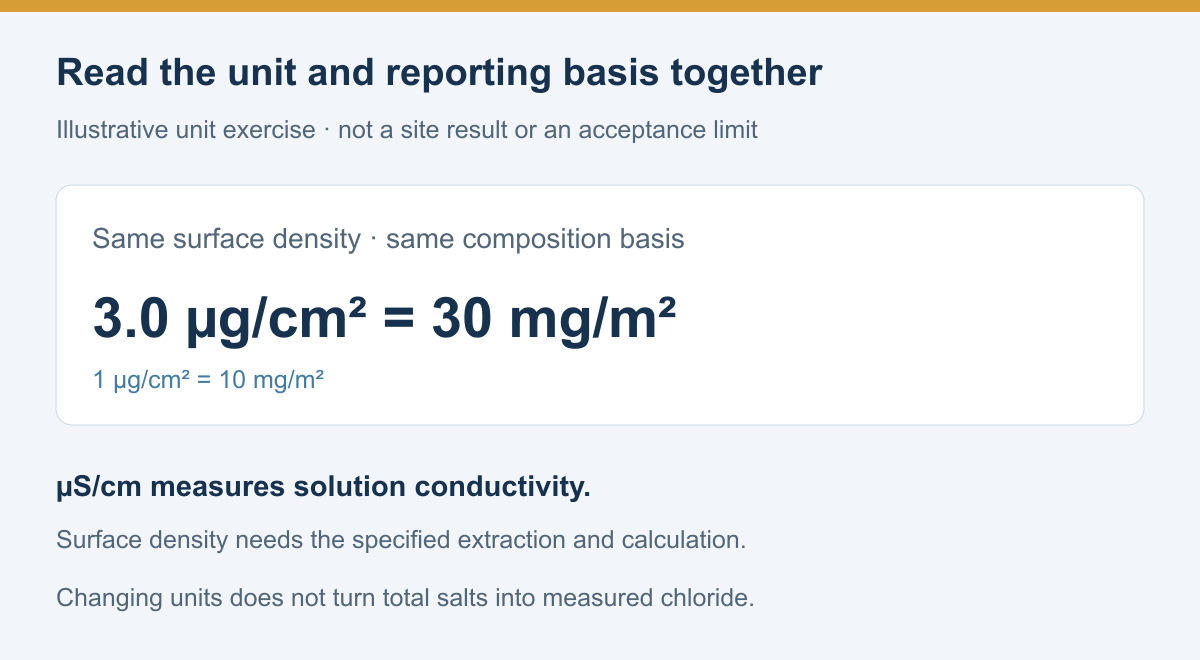
Original explanatory diagram. The quantities demonstrate units only; they are not project results or allowable limits.
There is no universal direct conversion from µS/cm to mg/m². Extraction geometry, water volume, background correction and the specified calculation matter. DeFelsko's result-interpretation guide explains why conductivity results and individual-ion tests cannot be compared as interchangeable numbers. A manufacturer's “Cl” calculation mode based on an assumed composition does not, by itself, constitute a selective chloride assay.
Take the acceptance criterion from the project
Neither the method name nor an instrument's green indicator establishes a universal marine-coating limit. Hempel's Inspection prior to painting distinguishes salt measurement from acceptance requirements, which depend on the specification and service conditions.
For release, check three things together: method, reporting basis and unit. If the specification requires chloride but the report contains a conductometric total, resolve that mismatch with the responsible technical authority. Do not select a conversion coefficient simply to produce a passing value.
Our marine epoxy primer preparation guide calls for removing salt and preparing steel to the project specification. The public JD documents reviewed for this article do not establish a product-specific salt acceptance threshold. Obtain the current product TDS, component SDS and approved coating specification before application; the public planning guide does not replace them.
Map locations, control contamination and document retests
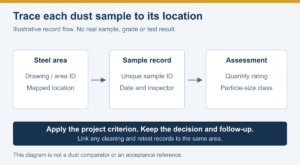
Use identifiable locations rather than an unexplained batch average. The inspection plan should consider the area's exposure history, drainage and geometry, previous contamination and the preparation stage. Record why locations were chosen and when testing occurred relative to cleaning and coating.
After a result exceeds the specified criterion, retain the original record, identify the affected area and follow the approved cleaning and retesting procedure. Keep wash water, handling and adjacent work from recontaminating prepared steel. The dry-docking surface-treatment guide provides the broader preparation sequence; salt testing verifies a separate cleanliness characteristic.
Identify retest locations and their relationship to the original point. Prior extraction changes the sampled spot, so follow the approved protocol rather than treating repeated extraction there as an independent initial test. Record leaks or other procedural defects as invalid tests with reasons, and preserve the record. Restore test locations as required before coating.
Use a traceable inspection record
The following blank template is an editorial inspection aid. It contains no measured project results and does not establish an approved sampling frequency.
| Record field | Information to enter |
|---|---|
| Traceability | Project, compartment or steel area, mapped test ID, date, time and inspector |
| Preparation stage | Cleaning/preparation completed, condition observed and nearby contamination sources |
| Procedure and equipment | Method/edition, patch or cell, extraction area, instrument ID and verification record |
| Extraction | Water source/quality, volume, contact/agitation details required by the procedure and validity observations |
| Conductivity | Background and sample readings where available; units, temperature treatment and automatic/manual correction status |
| Reported result | Corrected conductivity, calculated surface density, units and exact calculation/composition mode |
| Acceptance decision | Specification clause, matching criterion, pass/fail decision and authorized release |
| Corrective action | Affected area, cleaning action, retest IDs/results and final disposition |
Attach instrument exports and location photographs where required. Preserve original data when correcting a transcription or replacing an invalid test.
Frequently asked questions
Does an Sa 2½ visual preparation grade prove low soluble salts?
No. Visual rust cleanliness and water-soluble contamination are separate checks. A visual grade does not provide a salt measurement or replace the specified test.
Can I compare µS/cm directly with a limit in mg/m²?
No. One is solution conductivity; the other is surface mass density. Obtain the method-based calculation and its inputs, then confirm that its reporting basis matches the criterion.
Is a conductometric salt result a chloride measurement?
No. Conductometry responds to dissolved ions collectively. A chloride-specific requirement needs an appropriate measurement method and reporting basis agreed under the project specification.
Request a coating and inspection document review
Planning a primer application or ballast-tank coating project? Review the relevant marine epoxy primer options, then send JD Marine Paint your project details: substrate, service area, proposed coating system, specification clause, test method, result units and reporting basis. Include the inspection report if available so the technical inquiry can address the actual acceptance question.