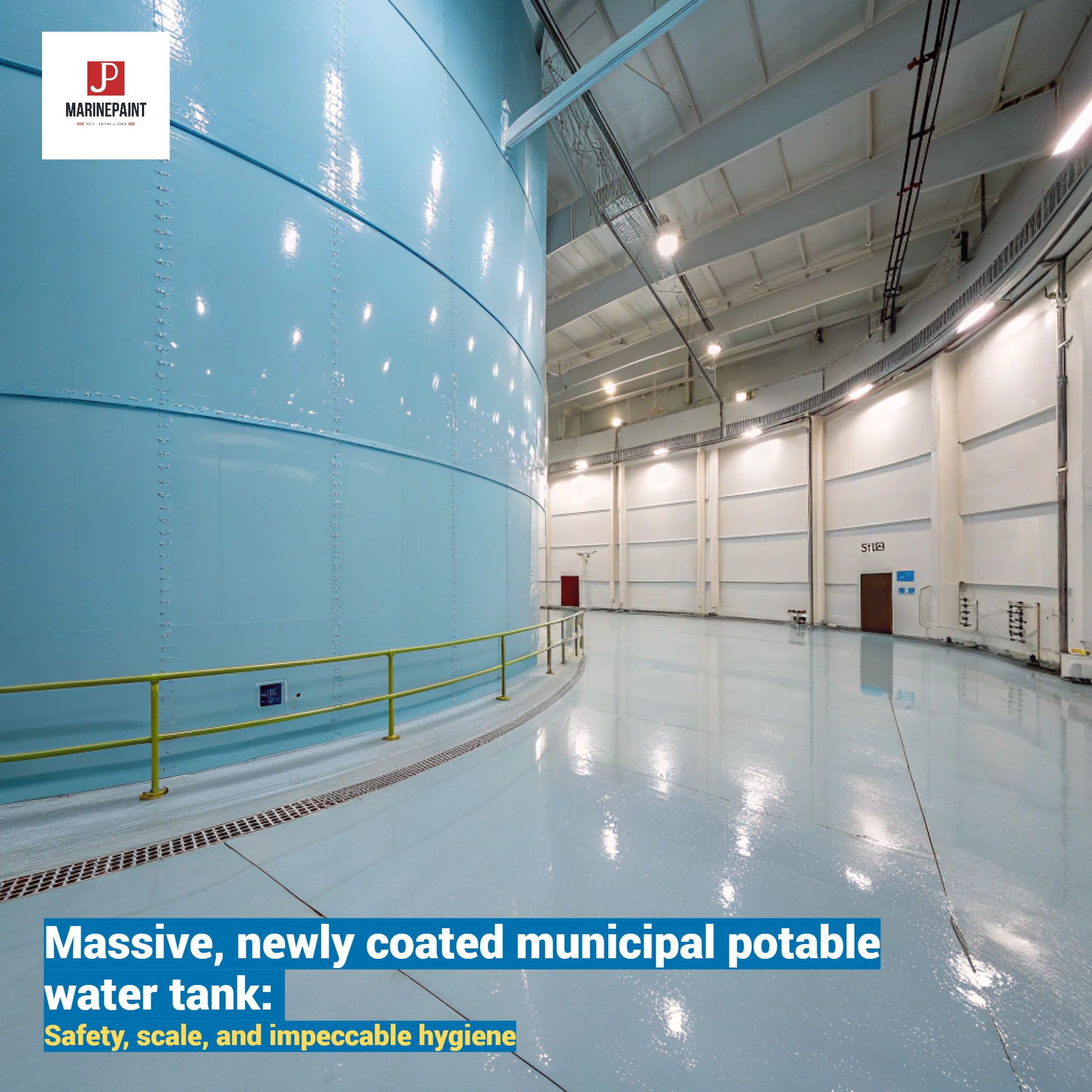
The most common potable water tank coatings are certified epoxy linings, including solvent-free and high-solids systems, plus selected cementitious, polyurethane, and other specialty linings where local approvals permit. The correct choice depends on the tank substrate, water-contact approval, application environment, curing schedule, repair needs, and documentation required by the owner or authority.
This article explains coating types and selection. For field execution, use the potable water tank coating application guide. For hygiene, certification, inspection, and crew safety, read the potable water tank coating safety guide.
Potable Water Tank Coating Types at a Glance
| Coating type | Typical strengths | Main selection checks |
|---|---|---|
| Solvent-free epoxy lining | High film build, low solvent content, dense barrier | Potable-water approval, application equipment, exotherm, cure and ventilation |
| High-solids epoxy lining | Strong adhesion, corrosion and chemical resistance, practical system design | Approved formulation, number of coats, solvent release, recoat window |
| Solvent-borne epoxy lining | Familiar application and penetration characteristics in suitable specifications | VOC rules, ventilation, retained solvent, full cure before water contact |
| Cementitious lining | Compatible with some concrete reservoirs and mineral substrates | Substrate movement, permeability, water chemistry, local approval |
| Polyurethane or polyurea specialty lining | Fast return-to-service or flexibility in approved systems | Application sensitivity, primer, moisture, equipment, potable-water certification |
| Repair and stripe-coat materials | Edge coverage and localized restoration | Compatibility with the original lining and approval for water contact |
1. Solvent-Free Epoxy Potable Water Tank Coatings
Solvent-free epoxy linings are widely considered for steel potable water tanks because they can build a dense protective film with minimal solvent release. They can reduce the risk of retained solvent odor when correctly mixed, applied, cured, and ventilated.
However, solvent-free does not mean risk-free or universally approved. High-viscosity material may need plural-component or heavy-duty airless equipment. Thick films can generate heat, sag, trap air, or cure unevenly if the product limits are exceeded. Always confirm potable-water certification for the exact product, color, thickness, and cure schedule.
2. High-Solids Epoxy Linings
High-solids epoxy combines practical spray application with strong barrier performance. Depending on the formulation, it may be applied as a multi-coat lining with stripe coats at welds, edges, brackets, and difficult geometry.
Selection should consider solids by volume, specified DFT, thinner limits, pot life, induction time, recoat interval, ventilation, and the minimum curing period before disinfection and filling.
3. Solvent-Borne Epoxy Linings
Solvent-borne epoxies remain in some established specifications, especially where application properties or repair compatibility favor them. The tradeoff is greater dependence on ventilation and solvent release. Filling the tank before full cure can cause odor, taste, soft film, blistering, or extractable-substance concerns.
4. Cementitious Coatings for Concrete Tanks
Cementitious linings can suit certain concrete potable-water reservoirs because they are compatible with mineral substrates and water exposure. They are not direct substitutes for steel-tank epoxy linings. Concrete moisture, cracks, laitance, movement, and water chemistry must be evaluated, and the exact product needs the required drinking-water approval.
5. Polyurethane and Polyurea Specialty Linings
Some approved polyurethane or polyurea systems offer fast cure, flexibility, or rapid return to service. Their performance depends heavily on substrate moisture, primer compatibility, mixing and spray equipment, application temperature, and applicator training. Certification must cover the intended potable-water use.
Which Coating Is Best for a Steel Potable Water Tank?
For many marine and industrial steel tanks, an approved epoxy lining is the starting point because it combines adhesion, corrosion protection, barrier performance, and repairability. The final decision should be based on:
- Approval for contact with drinking water in the destination market.
- Steel preparation standard, profile, salt limits, and access.
- Tank geometry, weld condition, edges, and stripe-coat requirements.
- Application method and achievable ventilation.
- Specified DFT and number of coats.
- Temperature-dependent recoat and cure schedule.
- Holiday testing, disinfection, flushing, and water-quality requirements.
- Availability of TDS, SDS, certificates, batch records, and inspection reports.
Potable-Water Approval Is Product-Specific
A resin family cannot be called potable-water safe by itself. Approval applies to a specific formulation under defined conditions, which can include substrate, primer, color, thickness, cure time, water temperature, and test standard. A generic industrial epoxy should never be substituted without documented confirmation.
Common regulatory or certification frameworks vary by country and project. Owners may refer to NSF/ANSI/CAN 61, WRAS, BS 6920, EU or national drinking-water requirements, maritime rules, or project-specific test reports. Confirm the current requirement with the authority, class, owner, and destination before purchase.
Coating Type by Project Priority
| Project priority | Coating direction to evaluate | Questions to ask |
|---|---|---|
| Low odor and dense high build | Approved solvent-free epoxy | Can equipment and temperature control handle the viscosity and film build? |
| Conventional airless application | Approved high-solids epoxy | How many coats and how much ventilation are required? |
| Concrete reservoir | Approved cementitious or specialty lining | How will moisture, cracks, and movement be managed? |
| Rapid return to service | Approved fast-cure specialty lining | Is the full cure and water-contact approval valid at project conditions? |
| Maintenance repair | Compatible approved repair system | Is the original lining identified, sound, clean, and within repair guidance? |
JDH912 Potable Water Tank Coating
JDH912 Epoxy Potable Water Tank Coating is JD Marine Paint’s product page for potable-water tank lining inquiries. Use that page for product positioning, documents, packaging, and quotation requests. Project suitability must be confirmed against the current TDS, certification documents, tank condition, and destination requirements.
For a complete commercial system rather than a single product, visit the potable water tank coating solution.
Selection Checklist
- Identify tank material, capacity, geometry, and existing lining.
- Confirm the governing drinking-water standard and required documents.
- Define preparation, salt limits, profile, and inspection hold points.
- Select the complete approved primer, lining, stripe-coat, and repair system.
- Check equipment, ventilation, temperature, humidity, and access.
- Plan curing, holiday testing, disinfection, flushing, and water-quality acceptance.
- Confirm quantity, delivery, shelf life, batch traceability, and technical support.
Frequently Asked Questions
Is every epoxy safe for drinking-water tanks?
No. Only use an exact product and system with the required potable-water approval and follow its specified thickness and cure conditions.
Is solvent-free epoxy always the best choice?
It is often attractive for high build and low solvent release, but equipment, film control, cure, certification, and project conditions determine suitability.
Can a potable-water coating be applied over an old lining?
Only after the old lining is identified, inspected, tested for adhesion and compatibility, and prepared under an approved repair procedure. Failed or unknown lining may require removal.
Send the tank substrate, capacity, existing lining, preparation method, operating water temperature, approval standard, schedule, quantity, and destination through the JD Marine Paint contact form for a system review.