Potable water tank coating safety depends on more than choosing an epoxy labeled for water service. The exact product must meet the required drinking-water standard, be applied at the approved thickness, cure under the stated conditions, pass inspection, and remain part of a controlled water-safety and maintenance program.
This guide covers health, hygiene, certification, documentation, and operational controls. Compare coating technologies in the potable water tank coating types guide, and use the application process guide for field execution.
Five Safety Controls for Potable Water Tank Linings
- Product approval: verify the exact coating system against the governing drinking-water requirement.
- Controlled application: prepare, mix, apply, and cure the lining within its approved conditions.
- Inspection and release: confirm film integrity, cure, cleaning, disinfection, and water quality before service.
- Traceable documentation: retain certificates, batch numbers, environmental records, DFT, repairs, and test results.
- Lifecycle hygiene: inspect, clean, sample, and repair the tank under a water-safety plan.
What Potable-Water Certification Actually Means
Certification evaluates a specific material or product under defined test and use conditions. It is not a blanket statement that every epoxy, every color, or every thickness from a manufacturer is safe for drinking-water contact.
NSF/ANSI/CAN 61 establishes health-effects criteria for materials and products in contact with drinking water; protective barrier materials such as paints and coatings are within its scope. NSF also makes clear that the standard does not by itself establish coating performance, taste and odor, or microbial-growth-support requirements. Owners should check the current official product listing, not only a brochure or an expired certificate.
In the UK framework, WRAS material approval is linked to BS 6920 testing. WRAS listings note that approval depends on the stated mixing and curing conditions. Other countries, flag states, class societies, owners, and water authorities may require different evidence.
Approval Questions to Check
- Is the exact product and manufacturer listed?
- Does the listing cover coatings or barrier materials for the intended use?
- Are color, primer, number of coats, and total thickness restricted?
- What cure time and temperature were approved?
- What maximum water temperature and surface-area-to-volume ratio apply?
- Is site application permitted, and are trained applicators required?
- Is the certificate current for the destination and project date?
Main Risks a Coating Program Must Control
Chemical Migration and Extractables
Unreacted components, solvents, additives, pigments, or breakdown products can enter the water if the wrong coating is used, components are mixed incorrectly, or the tank is filled before full cure. Product approval and cure verification are therefore inseparable.
Taste, Odor, and Appearance
Water can develop objectionable taste, odor, color, or turbidity from retained solvent, undercured film, contamination, cleaning residues, or stagnant water. A health-effects certification should not be assumed to cover every taste or odor requirement; confirm the project acceptance criteria separately.
Microbial Growth and Biofilm
Rough surfaces, sediment, stagnant zones, coating defects, and poor tank hygiene can support biofilm. The lining should be smooth, intact, cleanable, and part of a risk-managed potable-water system. The World Health Organization’s water-safety planning guidance recommends preventive risk management from source to consumer rather than relying only on end-point testing.
Corrosion and Coating Failure
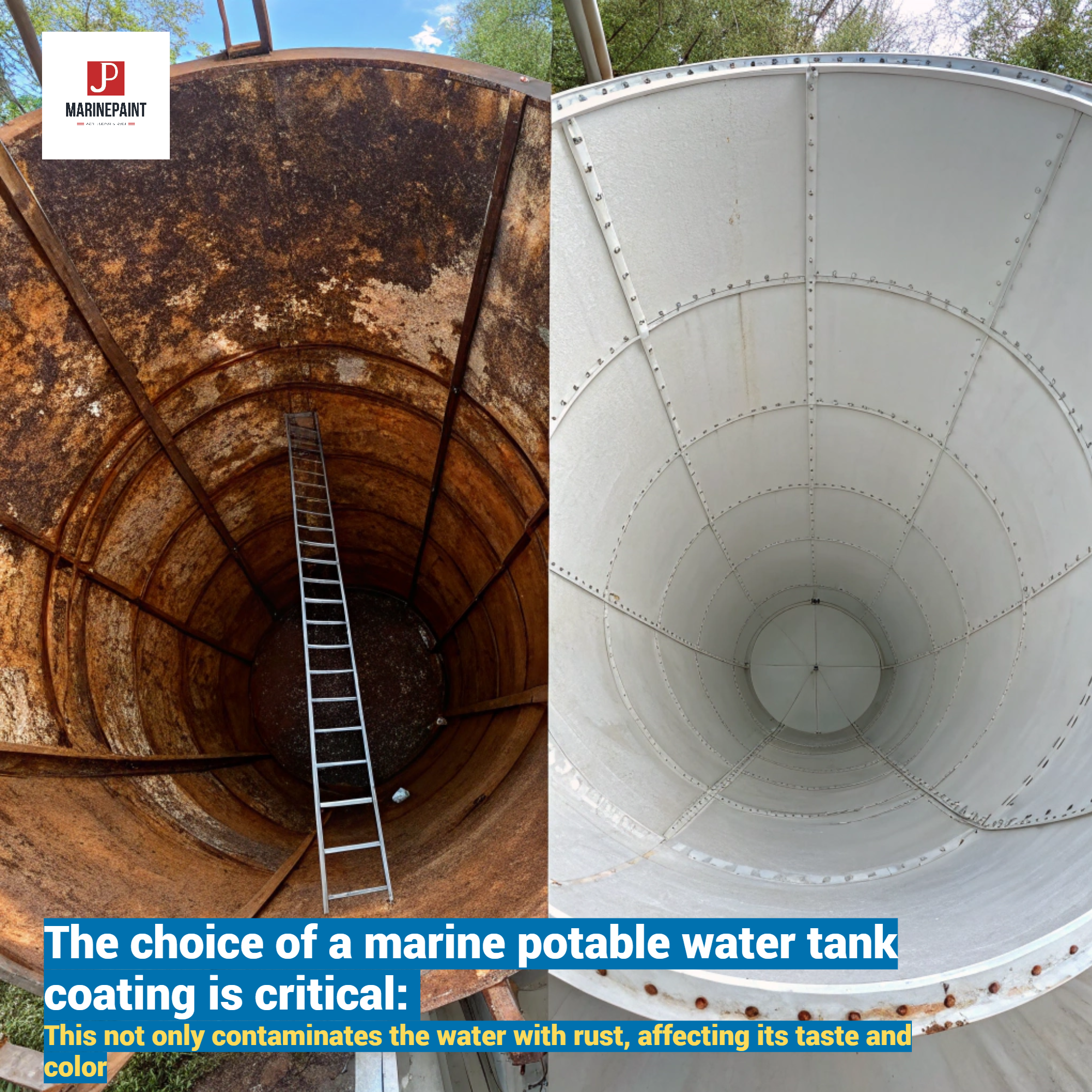
Holidays, low film thickness, salt contamination, mechanical damage, and poor edge coverage can expose steel and produce rust staining, contamination, leaks, or difficult-to-clean surfaces. Stripe coating, DFT control, holiday testing, and repairs protect both the tank and the water.
Application Controls That Protect Water Quality
| Control | Safety reason |
|---|---|
| Correct mix ratio | Supports complete chemical reaction and reduces unreacted components |
| Specified film thickness | Maintains barrier integrity without excessive retained solvent or cure problems |
| Temperature and ventilation | Supports solvent release and full cure throughout the tank |
| Clean abrasive and air | Prevents oil, dust, salts, and foreign material entering the lining |
| Recoat interval | Maintains intercoat adhesion and avoids contamination between coats |
| Full cure before filling | Reduces odor, taste, soft film, extractables, and early failure |
Inspection Before the Tank Returns to Service
- Visual inspection for misses, runs, contamination, pinholes, cracking, and repairs.
- Dry-film-thickness measurements against minimum, maximum, and average criteria.
- Holiday testing at the method and voltage agreed for the lining thickness.
- Cure verification using the product and specification requirements.
- Removal of equipment, abrasive, dust, containers, and all foreign material.
- Approved disinfection and flushing procedure.
- Water-quality sampling and acceptance before crew or public consumption.
Documentation Package
A defensible release record should include the current approval certificate or listing, TDS, SDS, coating specification, applicator records, batch numbers, shelf-life checks, surface-preparation and salt results, environmental logs, mixing and thinner records, stripe-coat records, WFT and DFT maps, holiday-test results, repairs, cure confirmation, disinfection, flushing, and water-analysis results.
Keep the documents for future inspection and repair. Without the original product, batch, and system information, later compatibility decisions become slower and riskier.
Safe Operation and Maintenance
Inspect tanks at planned intervals and after contamination events, structural work, long lay-up, taste or odor complaints, or unusual water results. Record corrosion, blistering, cracking, impact damage, sediment, and inaccessible areas. Use only compatible approved repair materials and repeat cure, disinfection, flushing, and acceptance steps after repair.
The latest WHO Guidelines for Drinking-water Quality provide a public-health framework based on health targets, preventive risk management, and independent surveillance. Vessel owners should integrate tank coatings into the broader water-safety plan, including source water, bunkering, transfer lines, treatment, storage, distribution, sampling, and corrective actions.
Questions for a Coating Supplier
- Which current potable-water certificates and official listings cover this exact product?
- What colors, primers, DFT, cure temperatures, and water temperatures are included?
- What application and ventilation conditions are mandatory?
- What holiday-test and repair procedure is approved?
- How long must the lining cure before disinfection, flushing, and filling?
- Which batch, inspection, and water-quality records should be retained?
JDH912 and Project Review
Use the JDH912 Epoxy Potable Water Tank Coating page for product and document inquiries. For complete system selection, preparation, application, inspection, and quotation requirements, visit the potable water tank coating solution.
Frequently Asked Questions
Does an NSF/ANSI/CAN 61 claim mean the coating is approved everywhere?
No. Confirm the current official listing, its use conditions, and acceptance by the destination authority, owner, flag, class, and project specification.
Can a tank be filled when the coating feels dry?
No. Touch dry is not full cure. Follow the approved potable-water cure schedule at the actual steel temperature and ventilation conditions.
Is water testing enough to release a new lining?
Water testing is one part of release. Product approval, application records, film integrity, cure, cleaning, disinfection, flushing, and operational controls are also required.
Send the vessel, tank material and capacity, existing lining, operating water temperature, required approval, application schedule, quantity, and destination through the JD Marine Paint contact form for technical review.