Can you paint over flash rust on marine steel?
Coat only when the steel's condition at application meets the exact primer requirements and the approved project specification. Flash rust is fresh rust that can develop on exposed steel after water cleaning. Its appearance alone does not authorize overcoating, identify salt contamination or establish that a surface is ready for an epoxy primer.
This guide addresses the inspection decision for water-cleaned carbon steel during ship repair and maintenance. It provides a suggested record and escalation workflow, rather than a cleaning specification. No universal acceptable grade or fixed number of hours before rusting is assigned here.
Separate the visual observation from other surface checks
A repair supervisor needs to know what changed since cleaning, which requirement applies and who can release the area. Start with the actual substrate and cleaning history. Do not label every orange mark as flash rust, especially when it is on remaining paint or its origin is unclear.
| Observation or check | What to establish | Keep the decision separate from |
|---|---|---|
| Newly rusted, exposed steel after water cleaning | Location, cleaning history and assessment against the adopted visual reference | Automatic permission to apply a primer |
| Possible soluble salts | Specified test, result, units and acceptance requirement | A visual rust classification |
| Suspected retained mill scale or old corrosion | Whether the preparation requirement was achieved | A fresh-rust label used to excuse incomplete preparation |
| Staining on retained paint | Substrate, source of staining and condition of the existing coating | A grade assigned to exposed steel |
| Surface profile | Specified measurement and required profile condition | A judgment based only on cleanliness |
The ISO 8501-4:2020 public catalog describes visual assessment after water jetting, including initial conditions and subsequent flash rust. It separately identifies invisible contaminants and profile as matters requiring additional assessment. See our guides to soluble salt testing and surface profile measurement for those distinct inspection records.
Use the specified visual reference correctly
ISO lists ISO 8501-4:2020, edition 2, as published and confirmed in 2026. Its grades use written criteria with representative photographs. The public abstract supplies scope and edition status; it does not replace the complete standard or its photographic references.
Before an inspection, identify the standard and edition adopted by the contract, obtain the relevant authorized references and confirm the inspector's procedure. Record the designation actually assessed. A web photo, phone-screen color or generated rust image cannot supply an acceptance classification by itself.
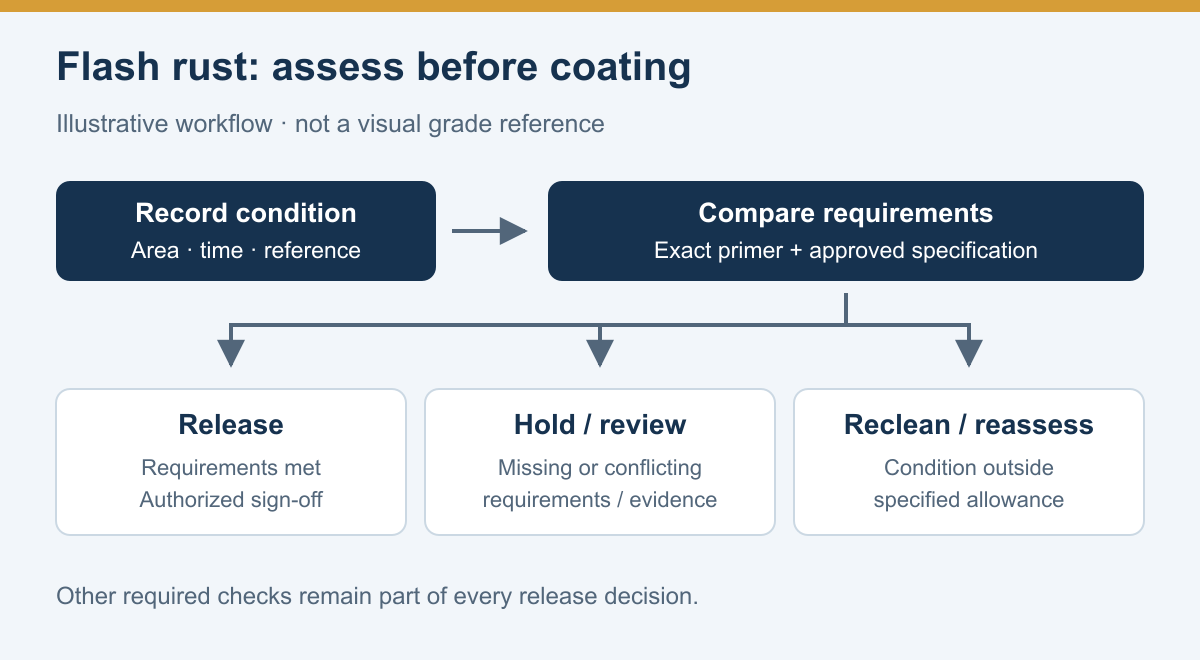
If site documents cite an older edition or a different reference system, raise the discrepancy with the responsible technical authority. Do not silently replace the contractual basis or translate between grade systems. Our diagram deliberately shows a decision process instead of simulated grade photographs.
Decide whether to release, hold or reclean
The following is a suggested coordination table, not a substitute for the approved inspection and test plan. Define its responsibilities and hold points before work starts.
| Situation at the pre-coating check | Suggested disposition | Evidence needed before application |
|---|---|---|
| Observed condition meets the written product and project requirements; other checks are complete | Request the designated release | Area identity, inspection results and authorized release record |
| Primer documents do not state an applicable flash-rust requirement, or instructions conflict | Hold the affected area for technical review | Written clarification for the exact primer, preparation method and service area |
| Observed condition exceeds the specified allowance | Reclean under an approved corrective procedure, then reassess | Corrective-work record and fresh inspection against all applicable requirements |
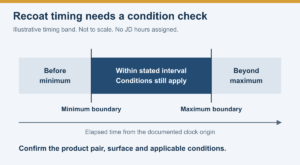
| Appearance has changed since the recorded assessment | Reassess before relying on the earlier release | Current observations, revised photographs and renewed disposition where required |
| Visual condition is acceptable but another required check is missing or fails | Keep the relevant hold point open | Completed or corrected test and release by the designated authority |
Ask a precise question when escalating: “For this identified area, this cleaning method and this observed condition, does the approved primer/system permit application, and what preparation or verification remains required?” Attach the record rather than asking whether “epoxy can cover rust” in general.
Hempel's May 2020 repair guidance connects allowable flash rust to the subsequent coating and specification. It also encourages minimizing delays after wet preparation. However, it cites an older ISO edition and discusses Hempel guidance: neither its grade advice nor another manufacturer's allowance establishes a JD requirement.
Keep a traceable pre-coating record
Use the blank structure below as an editorial planning aid. Your project may require additional fields, tests, frequencies and sign-offs. There are no measured project results in this example.
| Record group | Information to enter |
|---|---|
| Location and scope | Vessel/structure, compartment or zone, marked area, substrate and retained-coating boundary |
| Requirements | Approved specification/revision, inspection plan, visual reference/edition and applicable acceptance criteria |
| Cleaning history | Method, completion date/time and time zone, subsequent rinsing or corrective work, exposure or interruption history |
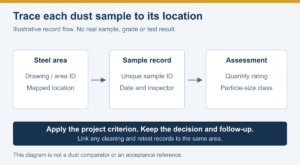
| Current condition | Assessment date/time, inspector, observed designation, photograph IDs and mapped locations |
| Environmental record | Air and steel temperatures with °C or °F, relative humidity in %, dew point and required margin with units; instrument IDs |
| Other inspection results | Required salt, profile, contamination and other checks, with methods, units, limits and report IDs |
| Release and application | Exact primer/system, document revision, disposition, authorized person's identity and coating start date/time |
Photograph a clearly identified area and retain both the wider location view and relevant detail. Record when the images were taken; avoid relying on an unlabeled close-up forwarded between crews. Agree how any changed condition will be reported before the applicator starts.
Coordinating smaller inspectable areas can make the handover easier. The appropriate work area and timing depend on the approved method, access and inspection resources. A schedule should not create permission to coat a surface that has not met its requirements.
What must be confirmed for a JD primer?
JD's primer preparation guide, revision 2026.07, calls for project-specific preparation and technical confirmation for repair applications. Begin with the marine epoxy primer range and identify the exact proposed product.
The public JDH818 product sheet mentions use after high-pressure water treatment, but it does not establish an ISO flash-rust acceptance grade. Its preparation instructions also need to be reconciled with the proposed repair method. The general “rough surface” description therefore cannot release a particular water-cleaned area.
Request the latest controlled TDS, relevant component SDS and written substrate-condition requirements for the intended system and service. We have not verified a current controlled JD instruction authorizing a specific flash-rust grade; no such allowance is assigned in this article. Product-specific environmental limits, preparation, drying requirements and compatibility must be confirmed before application. The broader primer application and troubleshooting guide covers the subsequent application workflow.
Frequently asked questions
Is light-looking flash rust always acceptable?
No. A casual description of its appearance is not an approved grade or a product allowance. Establish the specified assessment and compare the actual condition with the exact system's written requirements.
Does an earlier inspection still authorize painting after a delay?
Do not assume so when the surface has changed. Record the interruption and obtain the reassessment or renewed release required by the project procedure. This guide sets no universal inspection validity period.
Can a rust converter or inhibitor solve the issue automatically?
Do not introduce a treatment as an undocumented substitute for preparation. Ask for written confirmation of its compatibility with the exact coating system, required residue removal and subsequent inspection. A product label on an additive is not the coating manufacturer's approval.
Request a substrate-condition review
For a water-cleaned hull patch, tank area or deck repair, send JD Marine Paint the project details: cleaning method, completion and exposure history, mapped photographs, specified reference and acceptance requirement, proposed primer/system and service area. Include any conflicting document extracts so the technical discussion can resolve the actual hold point before coating starts.